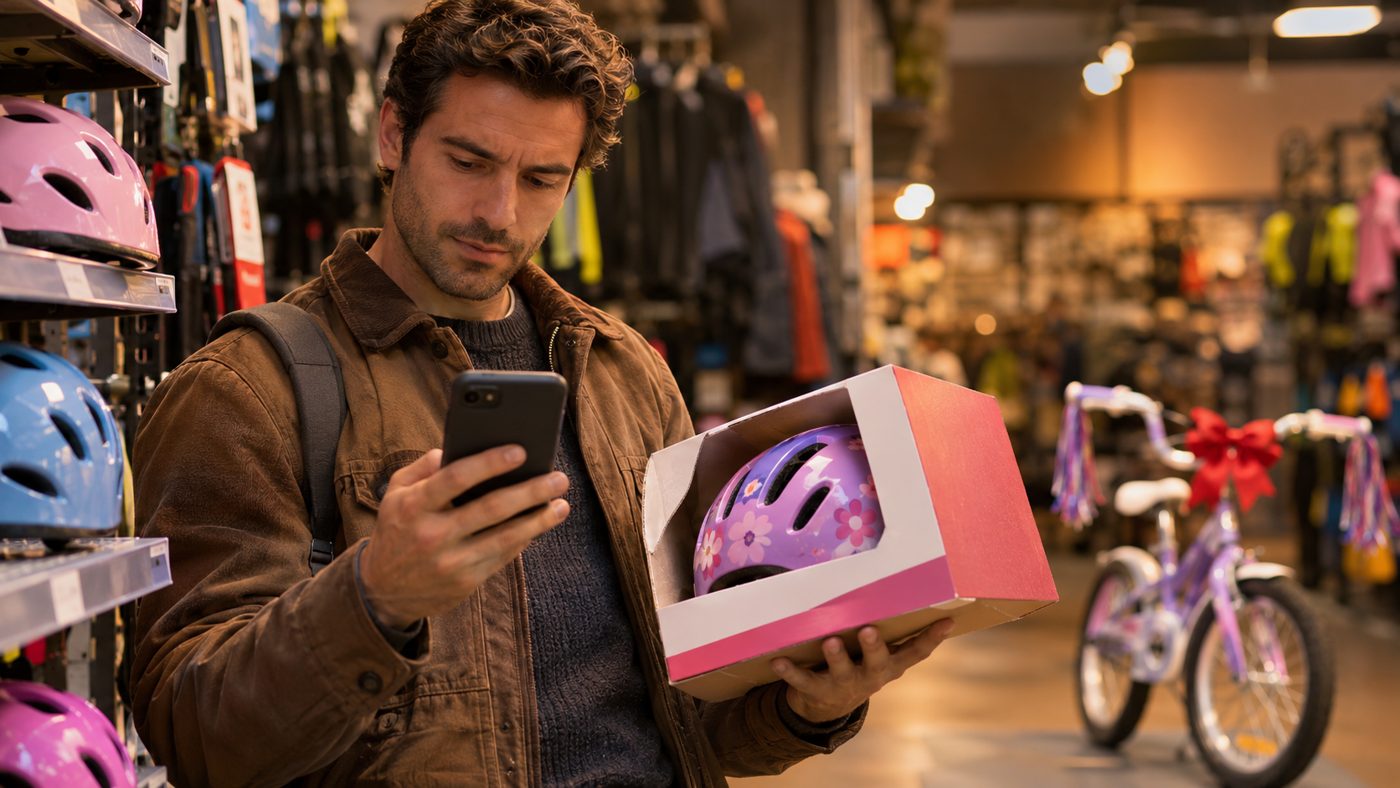
The bike is hidden in the garage under a moving blanket, bow already on. Still in your cart is the helmet: a cheerful box that says it fits ages 5 to 8.
Your kid is six. Done, right?
Not quite. That age range is a reasonable place to start looking, and nothing more. What decides which size to buy is the size of your child’s head today, and two kids the same age can be further apart on that number than you’d guess. Then comes the part that makes a helmet work: a proper fit.
If you read our guide to a kid’s first bike, the logic will sound familiar. “Room to grow” was the wrong rule for the bike. It’s the wrong rule for the helmet too.
The age on the box gets you close. The tape measure decides the size.
Children’s heads vary a lot within a single age. In a large federal survey that measured U.S. children between 1988 and 1994, the 5th percentile for five-year-old boys was 49.4 cm and the 95th percentile was 53.9 cm. So a smaller-than-most five-year-old head and a larger-than-most one sat about 4.5 cm apart.
Meanwhile, the typical head grows slowly at this stage. In the same survey, the median was 50.1 cm among three-year-old boys and 52.6 cm among seven-year-old boys, a difference of about 2.5 cm.
Put differently, the gap between a smaller-headed and a larger-headed five-year-old is bigger than the gap between a typical three-year-old and a typical seven-year-old.
| Boys, U.S. survey 1988–1994 | Head circumference |
|---|---|
| Age 5, 5th percentile | 49.4 cm |
| Age 5, median | 51.6 cm |
| Age 5, 95th percentile | 53.9 cm |
| Age 3, median | 50.1 cm |
| Age 7, median | 52.6 cm |
Those numbers are three decades old, so treat them as an illustration of a pattern, not as a sizing chart. And the pattern is the point: an age label describes a typical child, and your child may not be typical.
That’s why the helmet makers we checked size by head circumference, not by birthday. Giro, for example, lists its kids’ bike helmets in centimeters.
“Universal Child” isn’t one size
Here’s a detail worth knowing: the same size name can mean different ranges.
On Bell’s own size charts, the Universal Child size of the Lil Ripper covers heads of 18⅞ to 21⅝ inches. On the 2Twenty Youth Mips, Universal Child covers 18½ to 21¼ inches. Same brand, same label, different range.
Charts checked on manufacturer sites Nov 5, 2026; cm conversions approximate.
| Brand and model | Size | Head circumference |
|---|---|---|
| Giro (kids’ chart) | Universal Child | 47–54 cm |
| Giro (kids’ chart) | Universal Youth | 50–57 cm |
| Bell Lil Ripper | Universal Toddler | 17¾–20½ in (≈45–52 cm) |
| Bell Lil Ripper | Universal Child | 18⅞–21⅝ in (≈48–55 cm) |
| Bell 2Twenty Youth Mips | Universal Child | 18½–21¼ in (≈47–54 cm) |
| Bell 2Twenty Youth Mips | Universal Youth | 19⅝–22⅜ in (≈50–57 cm) |
So the rule is simple. Measure first, then check the chart for the exact model you’re buying, not the size name and not the age.
How to measure without spoiling the surprise
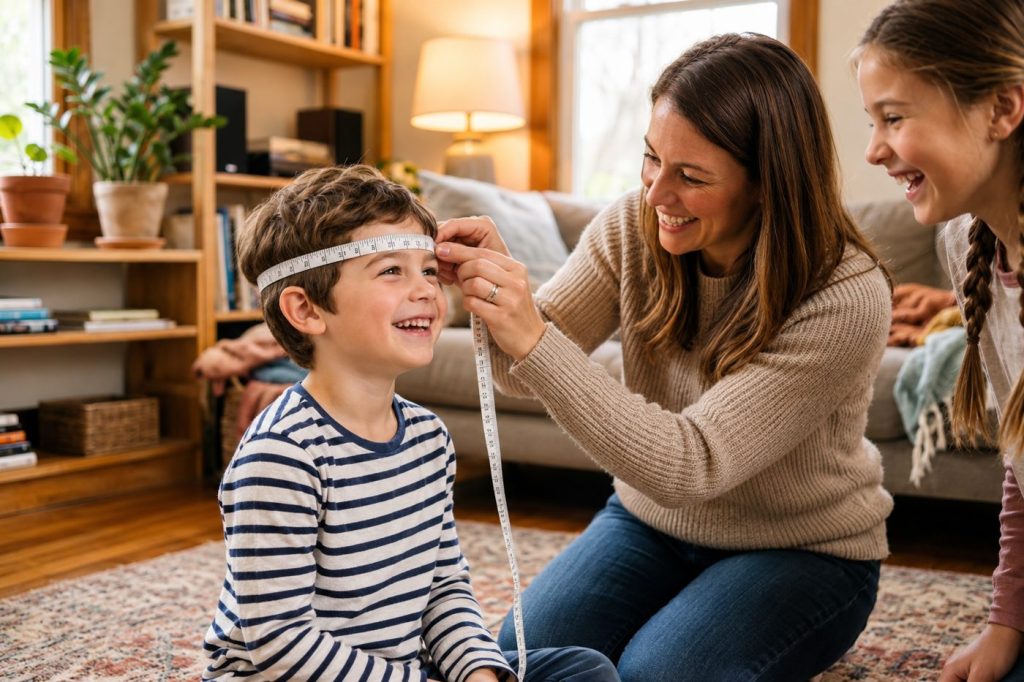
Measuring takes a minute. Wrap a soft tape measure around the head about an inch above the eyebrows, level all the way around. No tape? A piece of string and a ruler work. Bell’s guide adds a useful habit: measure twice and use the larger number.
Getting that number without giving the game away is the creative part. Measure the whole family “for fun,” or turn it into a contest over who has the biggest head.
Still, be honest about one thing. The Consumer Product Safety Commission recommends bringing the child along so the helmet can be tested for fit. A surprise skips that step, so build it back in:
- Buy from a store that lets you exchange the helmet.
- Choose a model whose published size range includes your child’s current measurement.
- Do the full fit check on gift day, before the first ride.
Measuring gets the surprise close. The fit check on gift day finishes the job.
Don’t buy a helmet to grow into
NHTSA’s current fit guide is blunt about this: never buy a helmet to grow into; wear one that fits now.
At first glance, that seems to clash with the American Academy of Pediatrics, which says a child’s helmet “should fit for several years.” In fact, the two agree. The AAP is describing a helmet that already fits today and adjusts as the head grows, since most come with removable pads that can be swapped for thinner ones. Starting oversized is a different thing entirely.
In other words, a good fit can last. A loose fit doesn’t turn into a good one by waiting.
Why fit matters as much as size
NHTSA sums up fit in what it calls the two-finger rule (you’ll also see it called “2-2-2”):
- Two fingers above the eyebrows. The front rim sits just above two fingers laid flat on the forehead, and the helmet sits level, not tipped back.
- A two-finger V around each ear. The side straps follow the V your fingers make.
- Two fingers under the chin. Buckled, the strap leaves room for just two fingers.
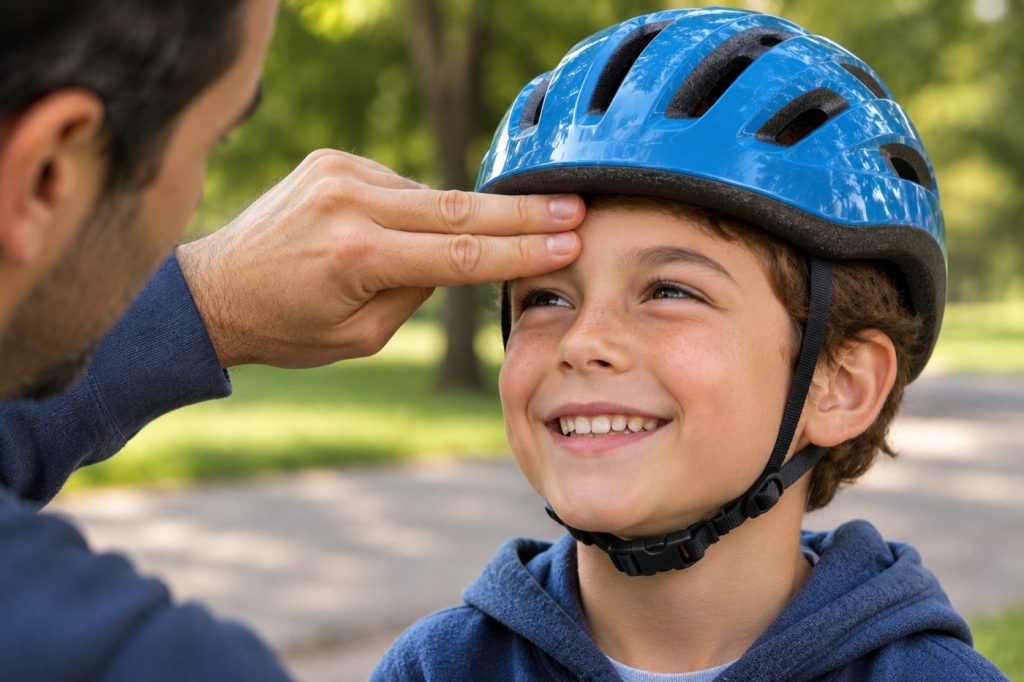
It sounds easy. Even so, it’s hard to get right. In a 2003 study at a pediatric practice in Falmouth, Massachusetts, only 4% of children and teens passed every check of helmet condition and fit. When a parent fitted the helmet alone, none of 52 passed. That was one practice, not a national sample, but it’s a useful warning that “it’s on their head” and “it fits” aren’t the same thing.
Fit also shows up in injury research. In a 1999 study, helmeted riders who reported a poorly fitting helmet had nearly twice the odds of head injury of those who said theirs fit well. A 2014 study of helmeted cyclists treated in Alberta emergency departments found the same direction: higher odds of head injury when the fit was poor, when the helmet tilted back, and most of all when it came off in the crash. Both studies show an association, not proof that fit alone caused the injuries. Still, they point the same way.
If the helmet won’t sit right, CPSC’s advice is to use the pads and adjustments that came with it and not to add your own padding. A helmet that doesn’t fit shouldn’t be worn.
The sticker that matters
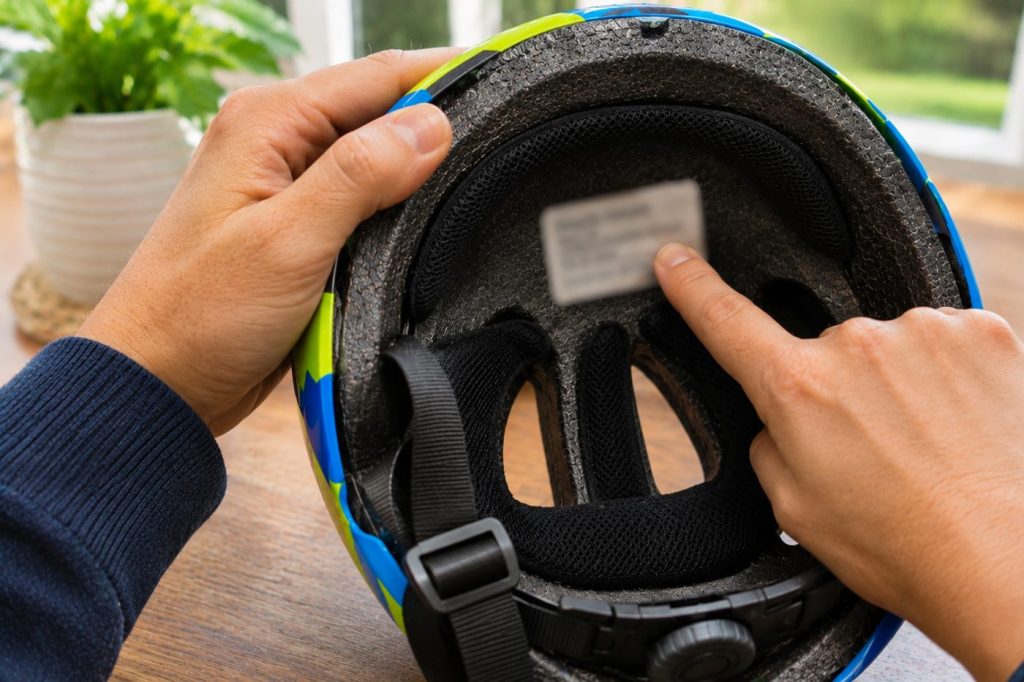
Every bike helmet made after 1999 for the U.S. market must meet the CPSC bicycle helmet standard. Look for the certification label on the helmet itself rather than trusting claims on the box. CPSC also warns against novelty or toy helmets that only look like the real thing.
For the youngest riders, the federal standard requires helmets labeled for ages 1 and older to cover more of the head than helmets for ages 5 and older. Bell’s Lil Ripper, for example, is certified for ages 1 and older with extended head coverage. If a toddler’s head is too big for those sizes, the Bicycle Helmet Safety Institute notes you may need a helmet made for ages 5 and up, giving up that extra coverage. Fit comes first.
There’s also something the sticker doesn’t promise. CPSC says no helmet design has been proven to prevent concussions. According to CPSC, what a helmet meeting the standard is designed to do, when it’s used properly, is protect against skull fractures and severe brain injuries.
One small rule kids won’t love: skip the decorative stickers on the helmet. CPSC says add-ons can hurt its performance. Decorate the bike instead.
When to replace it
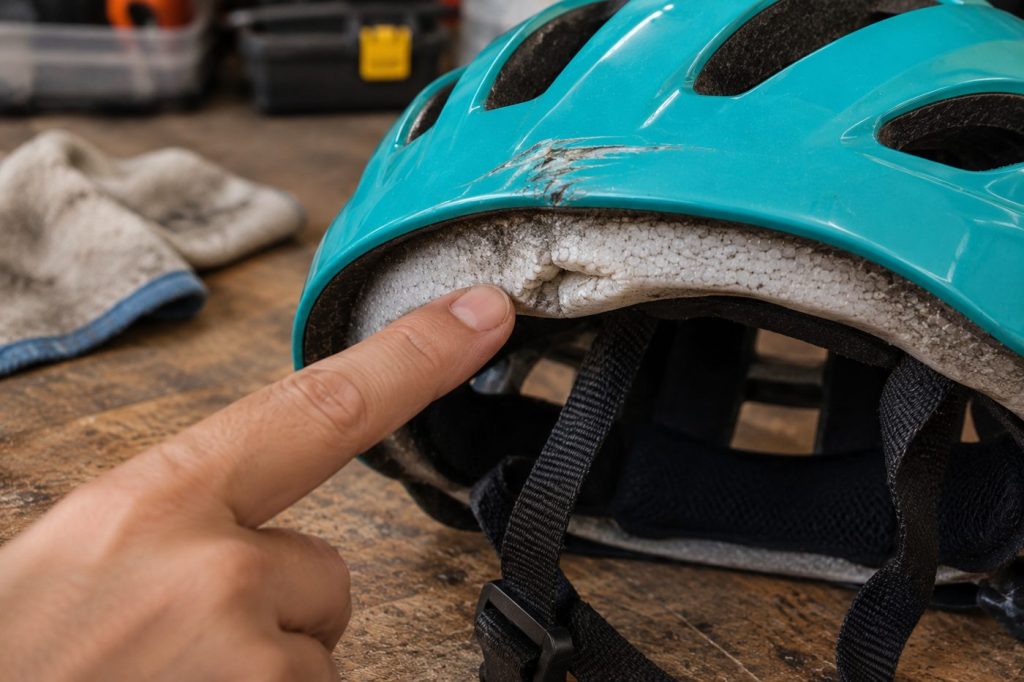
If your child crashes and the helmet takes a hit, replace it, even if it looks fine. CPSC explains that bike helmets are designed for a single impact: the foam crushes to absorb the energy and won’t protect the same way again.
Without a crash, follow the manufacturer’s guidance. If there isn’t any, CPSC says it may be prudent to replace a helmet within 5 to 10 years, while the AAP’s parent guidance says every 5 years or on the manufacturer’s timeline. Cracks, a loose shell, crushed foam, worn straps or missing pads are all reasons to replace it sooner.
Keep in mind, too, that a growing child may outgrow a helmet before it reaches any replacement date.
What about a hand-me-down?
The AAP is direct here: don’t resell, donate or buy a used bike helmet, because it may be too old to protect or may have been in a crash. The Bicycle Helmet Safety Institute adds a realistic caveat. If a family truly can’t afford a new one, a used helmet is better than none. But if you’re already buying a bike, a new, certified helmet that fits takes the guesswork about its history off the table.
It only works if it’s on
Across 40 studies of more than 64,000 injured cyclists, helmet use was associated with about 51% lower odds of head injury, 69% lower odds of serious head injury and 65% lower odds of fatal head injury. (That last figure refers to deadly head injuries, not all cycling deaths.) These numbers come from cyclists who had already crashed, and they describe odds, not guarantees. Even so, they all point in one direction.
None of that helps when the helmet stays on the hook. That’s why the habit matters as much as the purchase: helmet on before the bike moves, every time.
There’s one exception. Take it off at the playground. CPSC warns that children shouldn’t wear helmets on playground equipment or while climbing trees, because the strap can catch and pose a strangulation risk.
Back to the garage
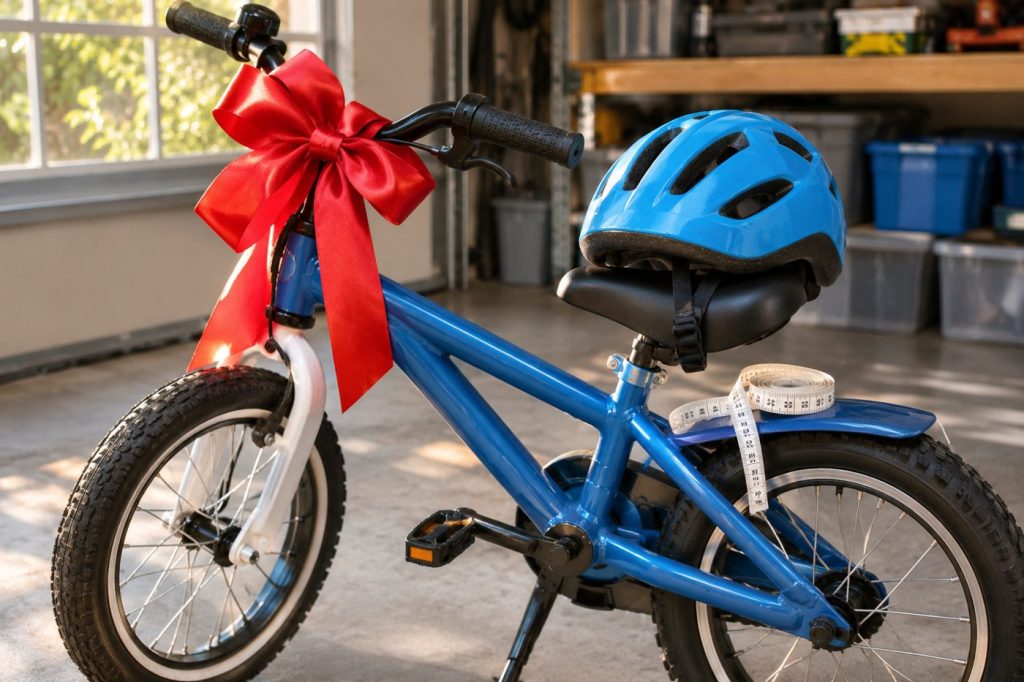
So before the bow goes on, get one number: your child’s head, measured today. Match it to the chart for the exact helmet, not the age on the box. Then, on the big morning, before anyone pedals off, do the two-finger check.
The bike is the gift. The helmet that fits is the part that has to work.
Sources
- National Center for Health Statistics, CDC (1988–1994 data). Table 40: Head circumference in centimeters for persons 3 months–7 years, by sex and age, United States, NHANES III. Archived copy, University of North Texas Libraries. Link.
- National Highway Traffic Safety Administration (2024). Fitting a Bicycle Helmet: the two-finger rule; never buy a helmet to grow into. NHTSA. Link.
- U.S. Consumer Product Safety Commission (2022). Which Helmet for Which Activity? Fit, certification, replacement and playground guidance. CPSC Publication #349. Link.
- Code of Federal Regulations. 16 CFR Part 1203, Safety Standard for Bicycle Helmets. Legal Information Institute, Cornell Law School. Link.
- American Academy of Pediatrics. Bike Helmets for Kids: Parent FAQs. HealthyChildren.org. Link.
- Giro (checked Nov 5, 2026). Bike helmet size guide, youth sizes (Universal Child, Universal Youth). Giro.com. Link.
- Bell Helmets (checked Nov 5, 2026). Lil Ripper: size chart, measuring guide and CPSC certification for ages 1 and older. Bellhelmets.com. Link.
- Bell Helmets (checked Nov 5, 2026). 2Twenty Youth Mips: size chart. Bellhelmets.com. Link.
- Parkinson GW, Hike KE (2003). Bicycle helmet assessment during well visits reveals severe shortcomings in condition and fit. Pediatrics 112(2):320–323. Link.
- Rivara FP, Astley SJ, Clarren SK, Thompson DC, Thompson RS (1999). Fit of bicycle safety helmets and risk of head injuries in children. Injury Prevention 5(3):194–197. Link.
- Romanow NR, Hagel BE, Williamson J, Rowe BH (2014). Cyclist head and facial injury risk in relation to helmet fit: a case-control study. Chronic Diseases and Injuries in Canada 34(1):1–7. Link.
- Olivier J, Creighton P (2017). Bicycle injuries and helmet use: a systematic review and meta-analysis. International Journal of Epidemiology 46:278–292. Link.
- Bicycle Helmet Safety Institute. Helmets for toddlers with large heads. BHSI. Link.
- Bicycle Helmet Safety Institute. Can I buy a used helmet at a yard sale? BHSI. Link.