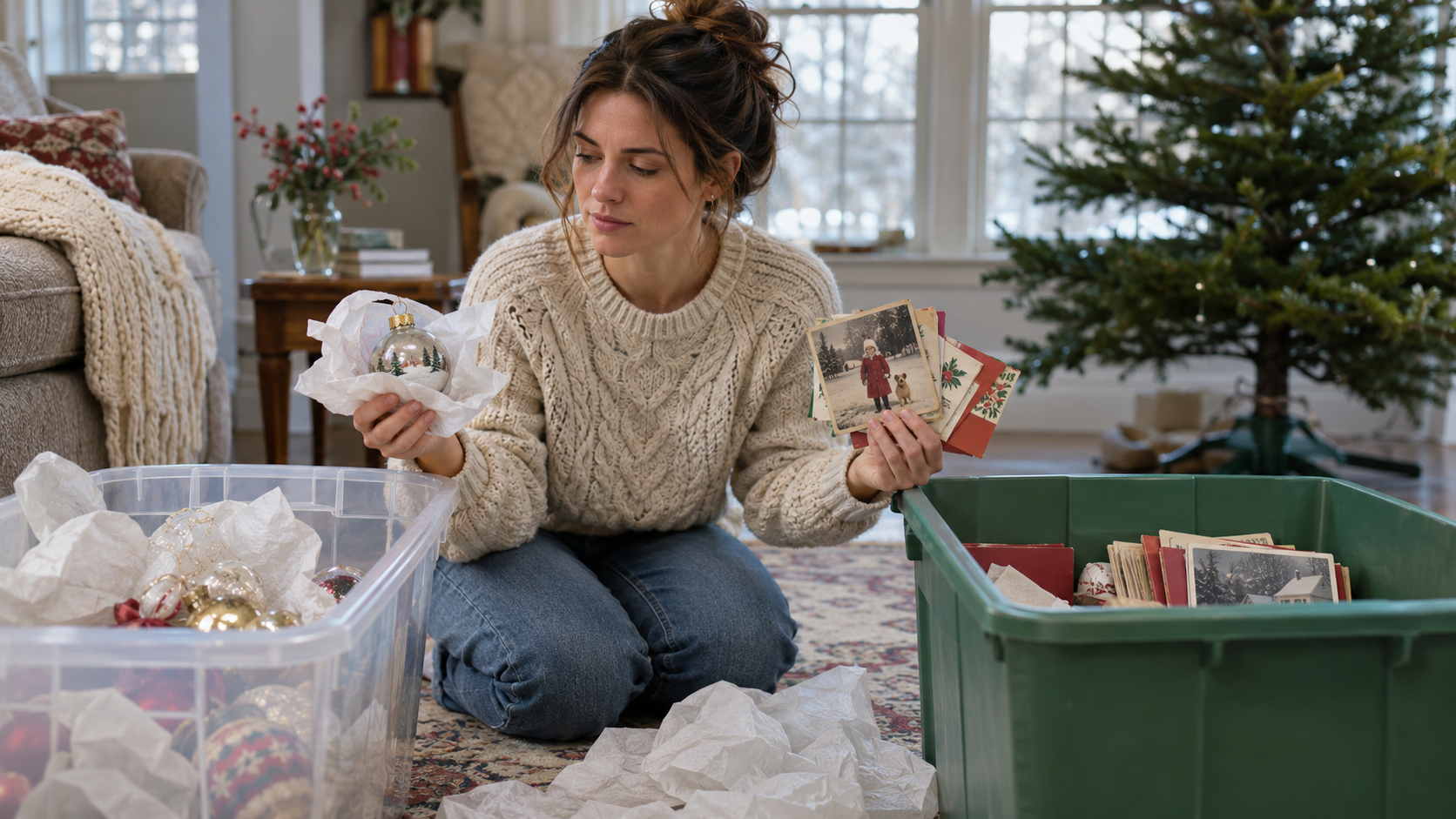
It’s the first week of January, and the living room is covered in tissue paper. Half the ornaments are off the tree. The other half are waiting on the couch.
So you stand in the storage aisle holding two bins. One is clear. The other is a solid red or green.
With the clear one, you can see what’s inside. But you’ve also heard that light fades things, and the solid one looks safer.
Here’s the thing: the color of the box is only part of the question. It changes what you can see, and, where light reaches the bin, how much light gets in. Protecting your decorations also depends on where that bin sits, whether everything goes in dry, and how each piece is packed.
Below is what conservation guides and official home guidance actually say about each of those, and where the evidence simply runs out.
What the Bin’s Color Actually Changes
Seeing what’s inside
A clear bin lets you spot the tree skirt without opening five lids. That’s a real convenience.
Still, it’s worth being honest about the evidence. We looked for research showing that seeing your stored things helps you find or use them, and we found no study directly comparing clear bins with labeled opaque bins for household storage. A clearly labeled opaque bin may work just as well.
Letting light in
Light damage is real, but it works like a dose. The Canadian Conservation Institute (CCI) explains that damage depends on how bright the light is and how long it lasts, and that it is “cumulative and irreversible.”
Visible light matters too, not just UV. In fact, the CCI notes that for sensitive colors, UV usually causes less than half of the fading.
Some materials fade far more easily than others. According to the CCI, most plant and insect dyes are highly sensitive, and so is dyed paper. Most mineral pigments, by contrast, hold up well.
What about the bin itself? Materials research on plastic packaging shows that pigmented plastic generally blocks more light than clear plastic. However, that research tested cosmetics packaging, not storage bins. It didn’t measure protection inside a household bin, so we can’t give you a percentage.
Put differently, a clear bin only matters for light when light actually reaches it. Inside a dark closet, very little does. Near a window, or under lights that stay on for months, it can add up.
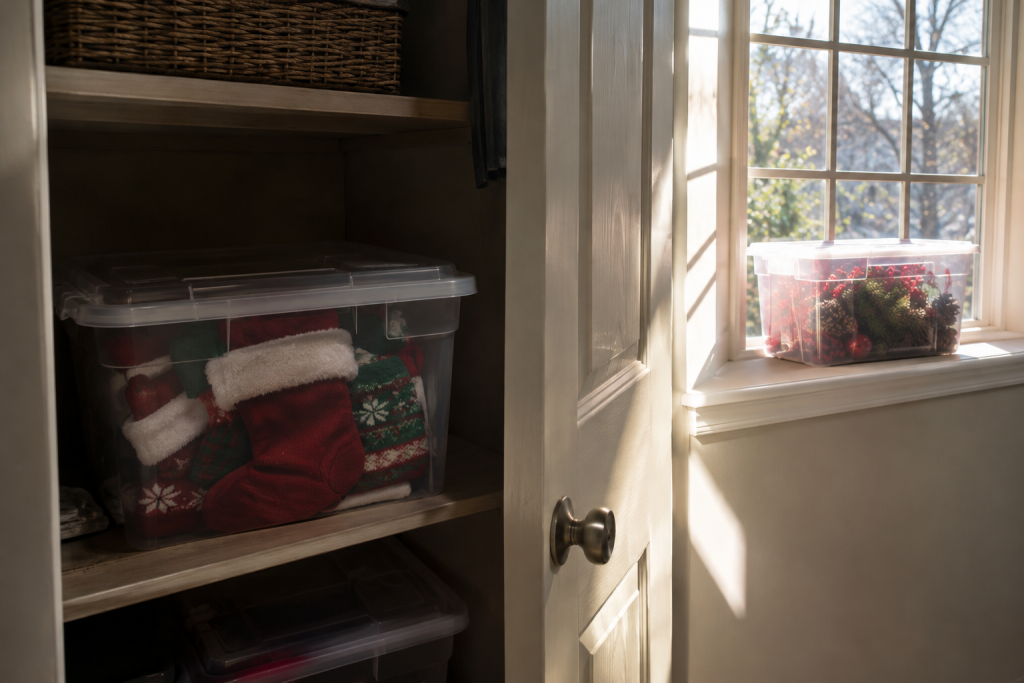
Protect light-sensitive pieces, such as dyed fabric, paper, and photos, with suitable wrapping or an opaque bin, ideally in a stable spot inside the house. That’s a precaution, not a proven fix.
What color doesn’t do
Opacity alone doesn’t make a bin resistant to heat, humidity, or pests.
In fact, even the bin itself has limits. The Library of Congress says plastic bins are a secondary defense against water, but they “do not offer protection against the deteriorating effects of environmental extremes.”
Which Storage Bin Fits What You’re Putting Away?
Here’s what each kind of decoration needs, and what backs each recommendation.
| What you’re storing | What to use | What backs it |
|---|---|---|
| Glass and ceramic ornaments | A sturdy bin with soft cushioning between pieces. An ornament maker also suggests wrapping each piece and using dividers. Clear or opaque won’t prevent breakage. | Conservation guidance (CCI) for cushioning; an ornament maker (Lenox) for wrapping and dividers. |
| Photos, cards, and paper keepsakes | An opaque bin or wrapping, kept indoors and away from damp basements, garages, and hot attics. For plastic, the Library of Congress lists polyethylene, polypropylene, and polyester as stable when they have no slip agents or coatings, and says to avoid PVC. Stable isn’t the same as archival. | Official guidance (National Archives, Library of Congress); light sensitivity from conservation guidance (CCI). The opaque bin is our precaution. |
| Stockings, tree skirts, and table linens | A polyethylene box or an acid-free box in a cool, dark, dry, ventilated spot. Not plastic garment bags. | Conservation guidance (CCI). |
| Kids’ handmade ornaments | Consider a separate box, with suitable wrapping for fragile or light-sensitive pieces, kept indoors away from light and damp. | Our precaution: their dyes, glues, and materials vary. |
| Sturdy plastic ornaments | A sturdy, appropriately sized lidded bin; clear lets you see what’s inside. If something has to go in the attic or garage, these may be more practical there than paper or fabric. Still, heat can accelerate chemical deterioration in plastics. | No study compares clear and opaque bins. The heat rule of thumb comes from conservation guidance (CCI); the rest is our synthesis. |
| String lights | Check them first and throw out damaged sets. Then a suitable, labeled bin in a dry place, out of reach of children and pets, with indoor and outdoor sets kept apart. | Official safety guidance (CPSC, ESFI). We found no evidence that one reel or organizer works better. |
| Battery-operated decorations | Remove the batteries before storing, and keep the decorations dry. Store removed batteries dry, at room temperature. Cover the terminals of used button batteries with non-conductive tape and take them to a collection point. Decorations that still hold button batteries belong out of children’s reach. | Battery makers (Duracell, Energizer) for removing batteries, and Duracell for storing them; official safety guidance (CPSC) for button batteries. |
That’s the short answer. For pieces made of more than one material, use the row for the most sensitive part. The sections below explain the reasons behind each row.
Where the Bin Sits
Attics, basements, and garages
This is where the sources agree most. For family papers and photos, the National Archives says: “Store items out of damp basements, garages, and hot attics.” The Library of Congress gives the same advice for anything of value, because those spaces control temperature and humidity poorly and leaks are more likely.
Heat is a big part of the problem. For plastics, the CCI gives a rule of thumb: the rate of chemical deterioration approximately doubles with each 5 °C (9 °F) increase. It’s a rough guide to how heat speeds up breakdown, not a prediction of how long any ornament will last.
Humidity and stability
Damp is the other half. The EPA recommends keeping indoor humidity below 60%, ideally between 30% and 50%. For family papers, the National Archives sets its line at below 65%, and it warns that below 15% paper turns brittle.
| Source | What it covers | What it says |
|---|---|---|
| EPA | Indoor humidity in the home | Below 60%, ideally between 30% and 50% |
| National Archives | Family papers | Below 65%; below 15%, paper turns brittle |
Those numbers don’t match. These recommendations cover different materials and purposes, and none sets a universal threshold for holiday decorations, so treat each as a range tied to its source.
Stability matters as well. For textiles, the CCI warns that sudden changes in humidity and temperature make fibers expand and contract. Glass and ceramics get a similar warning: the CCI says not to store them where temperature and humidity change in extreme or rapid ways. A closet inside the house usually avoids those swings better than a space that bakes in summer and freezes in winter.
If the attic is all you have
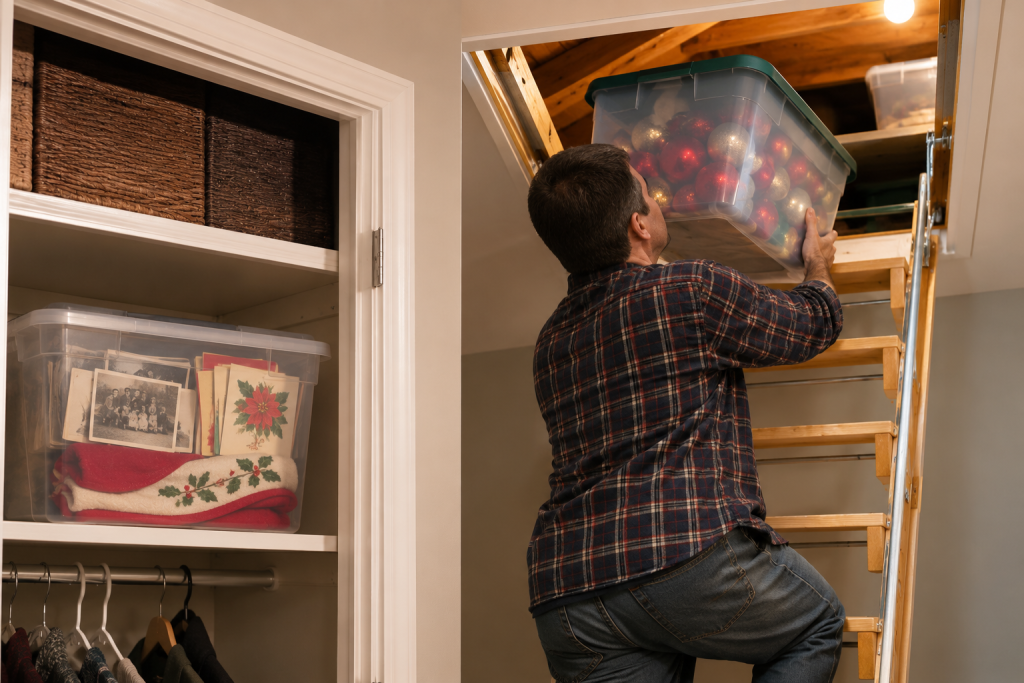
When it’s your only option, prioritize what goes there. Sort before you climb.
Sturdy, less sensitive pieces can go up there. Photos, papers, fabric, and the things you could never replace are better kept inside the living space, even if it means one bin in a bedroom closet.
Pests
Mice look for shelter. The National Pesticide Information Center advises removing nesting and shelter materials such as cardboard boxes and newspapers, and reducing clutter because it hides activity.
That doesn’t mean cardboard attracts pests. It means a corner full of old boxes gives them somewhere to live, and a crowded corner makes them harder to spot.
Dry Before You Seal
Airtight sounds like the safest choice. But it isn’t always.
The CCI cautions against plastic garment bags for textiles, because without air circulation, moisture can build up inside. That’s a warning about trapped moisture, not a verdict against every lidded bin. On top of that, the Library of Congress says plastic combined with high humidity raises the risk of mold, and that plastic sleeves shouldn’t be used for photos in storage without climate control.
Meanwhile, the EPA says drying wet items within 24 to 48 hours prevents mold in most cases. It also notes that condensation can be a sign of high humidity.
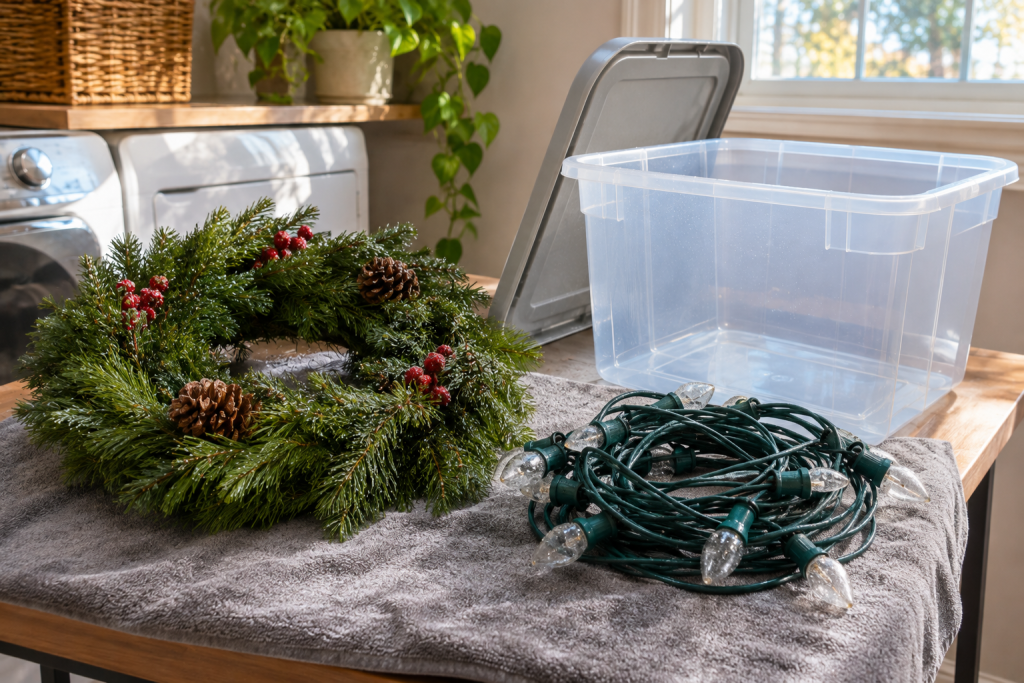
So seal only what goes in dry. If outdoor decorations come in damp from rain or snow, let them dry fully before the lid goes on.
How Each Thing Goes In
Glass and ceramic ornaments
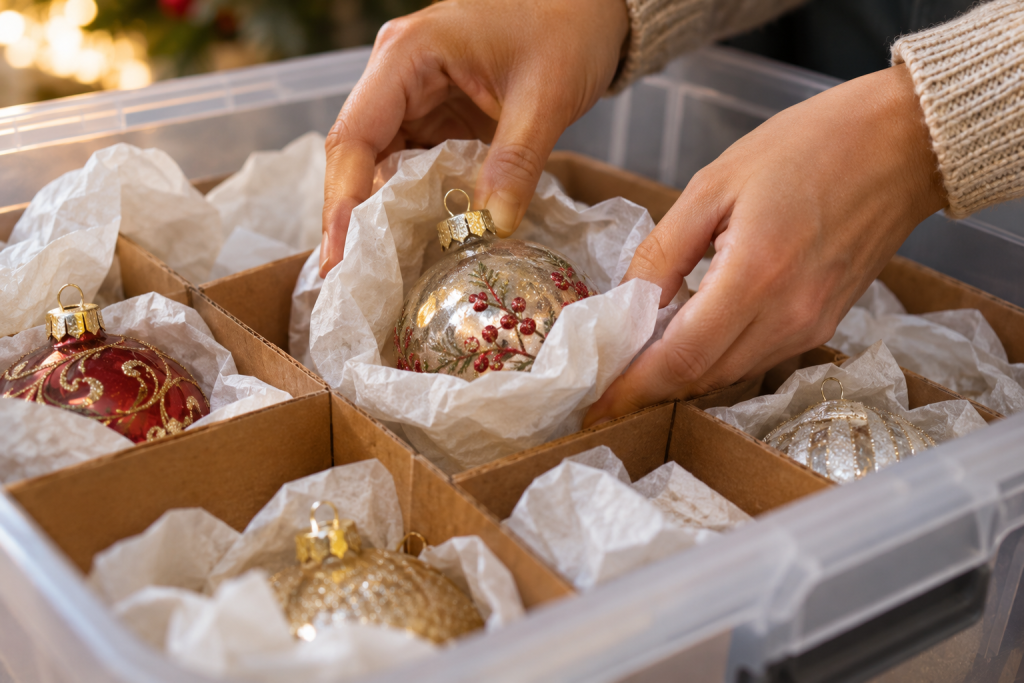
Breakage is its own kind of damage, and no bin color prevents it. When pieces are stacked, the CCI recommends a cushion of soft material between each one.
One ornament maker, Lenox, also advises wrapping each piece in tissue paper, using boxes with dividers, and skipping newspaper because the ink can transfer. It also warns against stacking too many boxes. That’s a manufacturer’s advice rather than independent research, but it’s consistent with the CCI.
Fabric: stockings, tree skirts, table linens
According to the CCI, textiles belong somewhere cool, dark, dry, and ventilated, and polyethylene boxes or acid-free boxes are acceptable. By contrast, it cautions against plastic garment bags.
Paper and photos
Cards, letters, and printed photos are among the most sensitive things in your holiday boxes. Keep them inside the house, away from light.
If you use plastic, the Library of Congress lists polyethylene, polypropylene, and polyester as stable when they have no slip agents or coatings, and it says to avoid PVC. Even so, a bin made from one of those plastics isn’t automatically archival quality. Additives and intended use still matter.
Kids’ handmade ornaments
Salt-dough stars and paper chains are often the pieces families care about most. Homemade ornaments may contain dyes, glues, and materials with different sensitivities. For that reason, treat them as sensitive: give them their own box, away from light and damp.
This is also where it helps to separate two kinds of storage. Ordinary decorations need ordinary care. Delicate sentimental pieces deserve the closet, the wrapping, and the extra attention.
Pieces made of more than one material
A wreath with fabric ribbon, or an ornament with a painted paper face, has more than one weak spot. In that case, pack it for its most sensitive part.
Lights and Batteries
String lights
Take-down is the best time to check them. The U.S. Consumer Product Safety Commission (CPSC) advises inspecting lights for broken or cracked sockets, frayed or bare wires, and loose connections, and throwing out damaged sets.
The Electrical Safety Foundation International (ESFI) adds three habits: store lights somewhere dry, keep them away from children and pets, and label indoor and outdoor sets separately.
Anything with batteries
Battery makers Duracell and Energizer both advise removing batteries from devices that won’t be used for several months. That covers most light-up figures and musical ornaments between January and December.
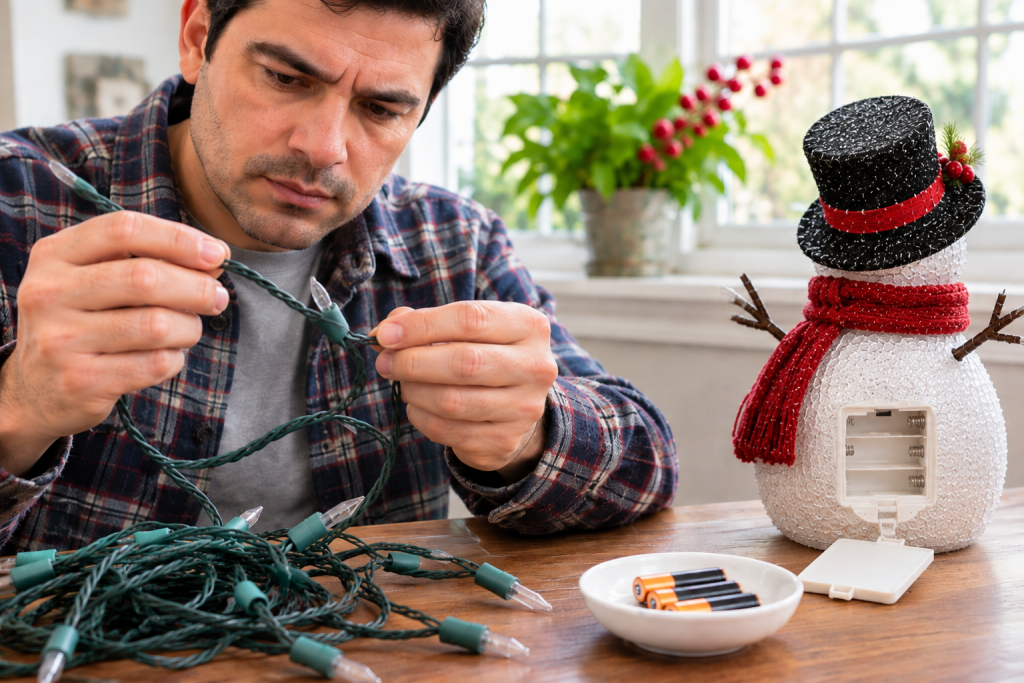
Button batteries need extra care. Once you remove a discharged one, the CPSC says to cover its terminals with non-conductive tape and take it to a recycling or collection point. Products with button batteries should also stay out of children’s reach. For more, see our guide to button batteries and magnets.
Put What You Use Where You Can Reach It
If the bin you open every year sits at the top of a ladder or under four other boxes, you’ll be climbing for it every December. Keep the yearly essentials where you can reach them without a ladder.
Labels help here, whatever the bin’s color. A clear bin shows you the contents. Meanwhile, a well-labeled opaque bin can also help you identify what’s inside. If your garage holds more than decorations, our guide to sports equipment storage covers the same reach-and-access thinking, and the junk drawer guide is a good home for the hooks, spare bulbs, and fuses you’ll want next year.
Before You Close the Lid
Run through a few quick questions:
- Is everything going in completely dry?
- Is anything here dyed fabric, paper, or a photo that should stay out of the light?
- Are the fragile pieces cushioned from each other?
- Have the batteries come out, and have the lights been checked?
- Is this box going somewhere hot, damp, or hard to reach?
The Short Version
Clear or opaque is a fair question. It just isn’t the only one.
Pick the bin for what’s inside. Pick the spot for what can ruin it.
Sources
- Canadian Conservation Institute (2018). Light, ultraviolet and infrared. Government of Canada. Link.
- Canadian Conservation Institute (2018). Basic care: Textiles. Government of Canada. Link.
- Canadian Conservation Institute (2018). Basic care: Glass and ceramic objects. Government of Canada. Link.
- Canadian Conservation Institute (2020). Caring for plastics and rubbers. Government of Canada. Link.
- Coltro, L., & Borghetti, J. (2007). Plastic packages for personal care products: Evaluation of light barrier properties. Polímeros, 17(1), 56–61. Link.
- National Archives. Storing your family archives. U.S. National Archives and Records Administration. Link.
- Library of Congress. Preservation FAQs: General. Library of Congress Preservation. Link.
- Library of Congress. Care, handling, and storage of photographs. Library of Congress Preservation. Link.
- U.S. Environmental Protection Agency. A brief guide to mold, moisture, and your home. EPA. Link.
- National Pesticide Information Center. Mice. Oregon State University and U.S. EPA. Link.
- U.S. Consumer Product Safety Commission (2013). “Deck the Halls” safely: CPSC estimates more than 15,000 holiday decorating injuries during November and December. News release 14-042. Link.
- Electrical Safety Foundation International (2019). Avoid serious electrical and fire hazards decorating your home this holiday season. ESFI. Link.
- U.S. Consumer Product Safety Commission. Button cell and coin battery information center. CPSC. Link.
- Duracell. Battery storage. Duracell (manufacturer guidance). Link.
- Energizer (2007). Design and safety considerations. Energizer (manufacturer guidance). Link.
- Lenox. How to store ornaments. Lenox (manufacturer guidance). Link.