

If you think your child swallowed a button battery or a magnet, go to the emergency room now. Don’t wait for symptoms.
For help on the way, call the National Battery Ingestion Hotline at 1-800-498-8666 or Poison Control at 1-800-222-1222. Full steps are below.
Picture a December evening. You’re picking up wrapping paper from under the tree when your hand finds something small and plastic: the back cover of the little remote for the tree lights.
The remote itself is on the couch. Its battery compartment is empty.
Maybe the battery rolled under the furniture. It’s also possible someone took it out weeks ago and forgot. Or did your toddler, who was playing right here an hour ago, find it first?
You probably can’t tell which. That uncertainty is the whole problem, and it’s why this guide starts with your house instead of the toy aisle.
The Store Is Only the First Check
When you buy a toy, you’re trusting that it meets a safety standard. That’s a reasonable place to start. But button batteries and magnets don’t only come in toys, and the rules that cover them depend on what kind of product they’re in.
In the U.S., toys follow their own mandatory toy standard. Most other products with button batteries, from remote controls and car key fobs to light-up shoes for kids, follow a separate federal rule created under a 2022 law known as Reese’s Law. That rule covers products made or imported after October 23, 2023.
| Product | Which rule applies | Applies to products made or imported since |
|---|---|---|
| Toys for children under 14 | Federal toy standard (16 CFR 1250, ASTM F963) | April 20, 2024 (ASTM F963-23) |
| Other products with button batteries, including kids’ products that aren’t toys | Reese’s Law rule (16 CFR 1263, UL 4200A) | October 23, 2023 |
| Button battery packaging | Warning-label rule (16 CFR 1263.4) | September 21, 2024 |
In its 2024 proposal, the federal safety agency, the CPSC, said the requirements for toys weren’t as stringent as those for other products. It also proposed tougher rules specifically for toys with button batteries.
Meanwhile, the date you bought something isn’t the date it was made. Older products, built before any of these rules took effect, can still be in your home.
And the problem hasn’t gone away. A 2026 study of national emergency room data found that button battery visits by U.S. children kept rising from 2020 to 2024, from 5.1 to 8.8 per 100,000 children, even as the number of children declined. The study doesn’t explain why.
A toy that meets the standard is a good start. It isn’t a home check.
Why a Button Battery Isn’t Like Anything Else a Child Swallows
A button battery isn’t dangerous just because it’s small. The real danger is what it does once it gets stuck.
If one lodges in a child’s esophagus, its electrical current reacts with the body’s fluids and produces a caustic chemical at the battery’s negative side. That chemical burns the tissue around it. According to the CDC, serious burns can happen in as little as two hours.
Two hours isn’t a window to wait and see. It’s the reason not to wait at all.
What makes this so hard is that you may never see it happen. The early signs can look like an ordinary illness: vomiting, stomach pain, fever, coughing or trouble swallowing. On top of that, a young child may not be able, or willing, to tell you what went into their mouth. In a CDC review of 14 children who died after swallowing batteries, at least nine of the cases were unwitnessed or diagnosed late.
Even removing the battery doesn’t always end the danger. In that same review, some children suffered fatal bleeding days or weeks after the battery was taken out.
Lithium coin cells are the worst, but none are safe
The batteries most often behind serious injuries are 3-volt lithium coin cells about 20 millimeters wide, like the common CR2032, somewhere between a penny and a nickel in size. Still, smaller button batteries can also cause serious injury or death, especially in babies under one, according to the National Capital Poison Center.
In other words, no button battery is safe for a small child to swallow.
Why Swallowed Magnets Can Cause Serious Internal Injuries
Magnets hurt in a different way. When a child swallows two or more strong magnets, or a magnet along with a piece of metal, they can pull toward each other through the walls of the intestine. According to the CPSC, that can cause holes, blockages, serious infection and even death.
An X-ray doesn’t always settle the question, either. Several magnets stuck together can look like a single object.
That’s why the advice doesn’t depend on how many magnets you think went down: if you suspect any, get medical care right away.
This isn’t only a toddler problem. Younger children may mistake small, shiny magnets for candy. Tweens and teens, on the other hand, have swallowed them after using them as fake lip or tongue piercings.
A pattern worth knowing
Researchers who studied national emergency room data found that visits for swallowed magnets fell during a period of federal action against small, powerful magnet sets, including a 2014 rule restricting their sale. After a court struck that rule down in 2016, visits rose again. The study counted all swallowed magnets, not only the strongest ones, so it shows an association over time rather than proof that the rule caused the change.
A newer federal rule for magnet products that aren’t toys took effect in October 2022, and a federal appeals court upheld it in 2025. Even so, magnet sets bought before then may still be sitting in your home.
The Home Check
Here’s where all of this turns into something you can do tonight. Walk through your home with four groups of things in mind.
Think of it as spotting hazards, not certifying products. You can’t tell whether something meets a federal standard just by looking at it. Still, you can see a lot.
Anything With a Battery Door
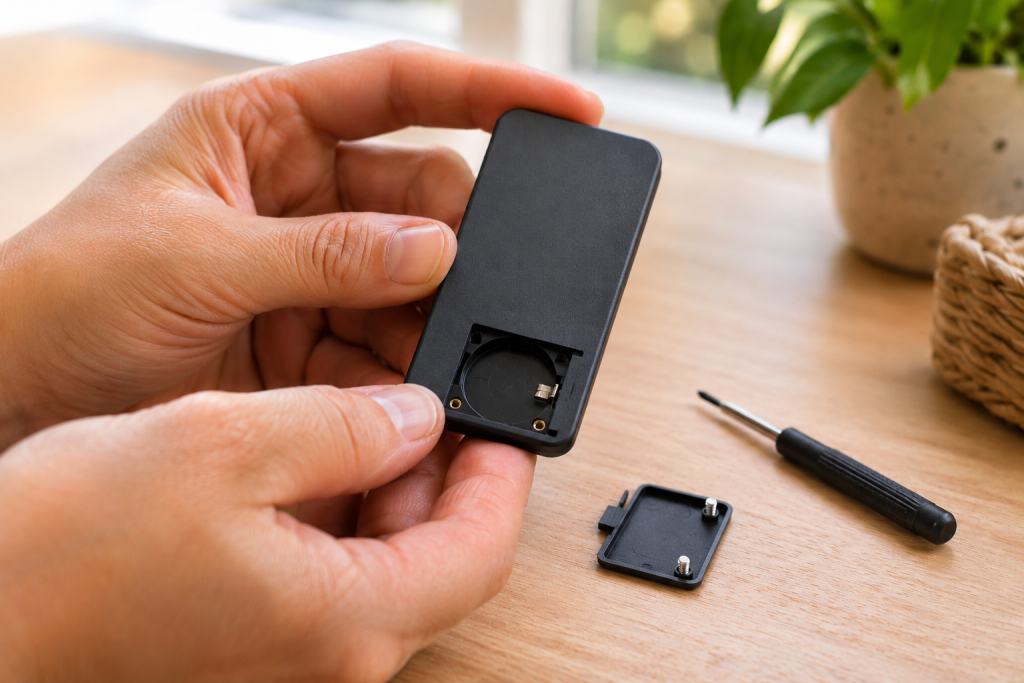
Start with anything that has a small battery compartment: TV and streaming remotes, car key fobs, garage door openers, bathroom scales, watches, thermometers, musical greeting cards, and anything that lights up.
That’s not a small group. In an analysis of 8,648 battery ingestions reported between 1990 and 2008, about six in ten batteries swallowed by children under six came straight out of a product, rather than from a package or a loose pile.
For each item, ask:
- Does the battery cover open without a tool?
- Is a screw missing, loose or stripped?
- Is the cover cracked, loose, damaged or already coming off?
Any “yes” is a reason to move that item out of reach until you deal with it. (More on that in the next section.)
Batteries That Seem Dead
A battery that no longer powers a remote can still hurt a child. According to Poison Control, spent button batteries usually keep enough charge to cause serious damage if swallowed. Children have swallowed dead batteries that were left on a counter as a reminder to buy new ones, or that they pulled out of the trash.
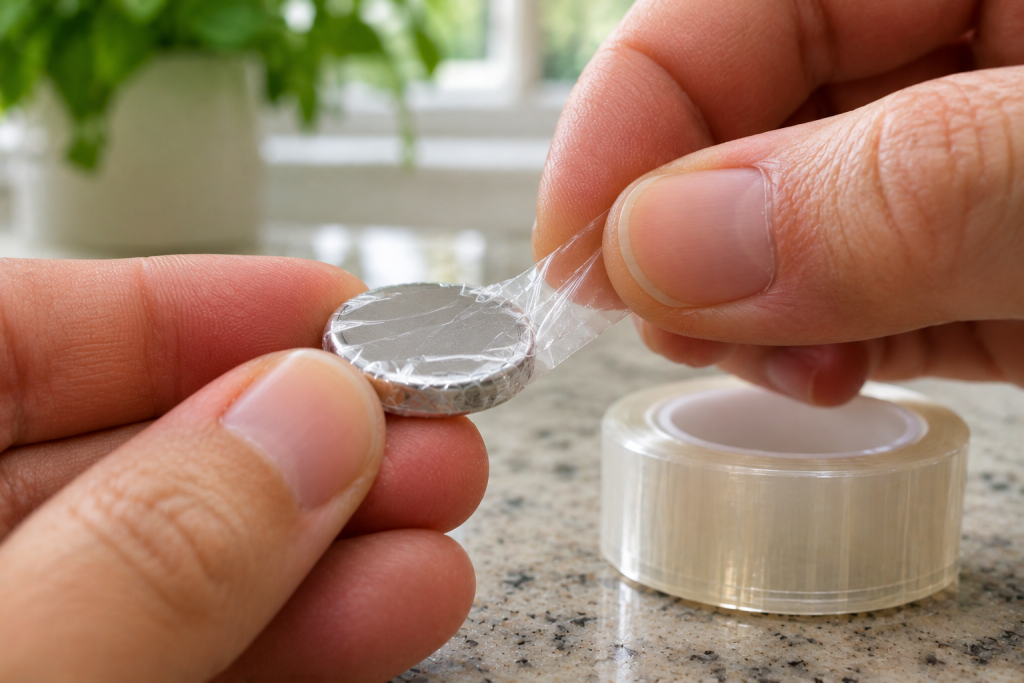
So handle old batteries in three separate steps:
- Insulate it. Wrap tape all the way around the battery, twice.
- Store it out of reach until you can get rid of it.
- Recycle or dispose of it according to your local guidelines.
Also, try not to change batteries in front of young children. If your house has a junk drawer, it’s worth checking too.
Holiday Things That Light Up
Light-up party favors and decorations keep showing up in federal safety notices. In April 2026, for example, the CPSC announced a recall of Christmas light-up rings sold online, each holding three button batteries, because they violated the federal toy standard.
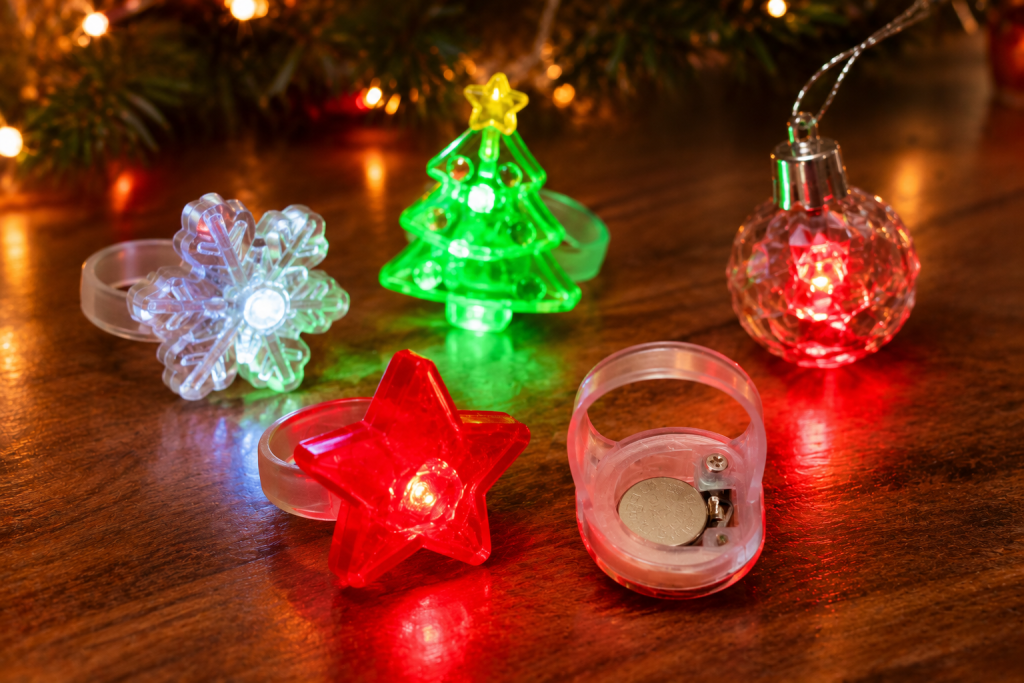
The year before, in June 2025, the agency warned consumers to stop using a light-up Nativity set whose battery compartment children could easily open. The seller hadn’t agreed to a recall. In that case, there was no recall to find, only a public warning.
When you check a holiday item, search both the CPSC’s recalls and its product safety warnings.
Magnetic Toys and Desk Sets
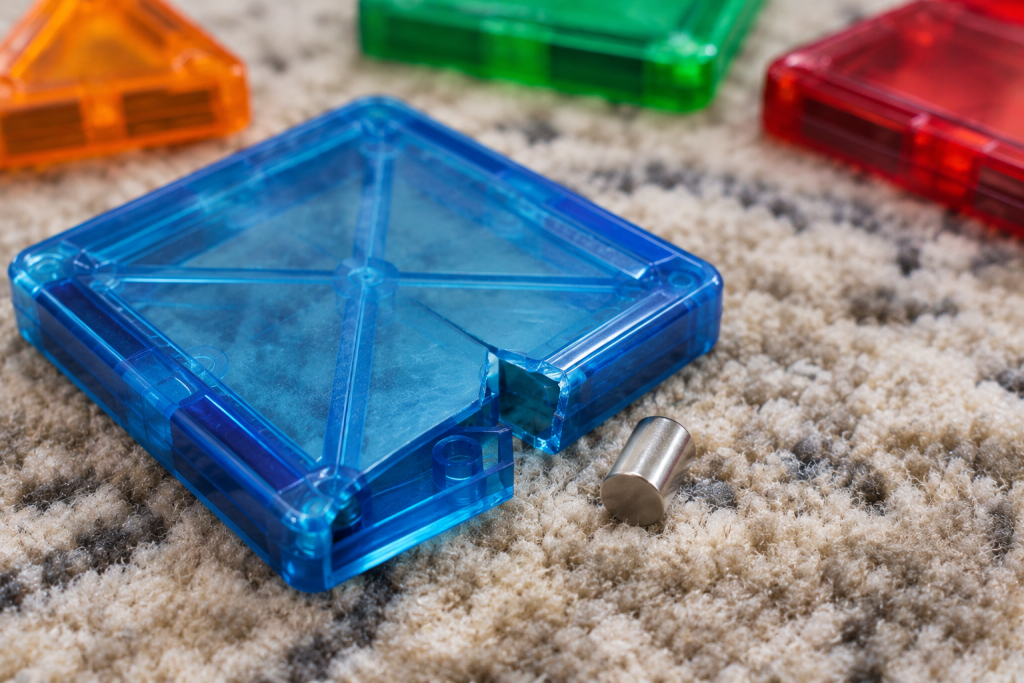
Look beyond the obvious magnet sets. Magnetic building blocks and cubes have small magnets inside, and those can come loose if a piece breaks or opens. In August 2026, the CPSC told parents to stop using one brand of magnetic building blocks for exactly that reason.
So check for cracked, split or opened pieces, and set aside anything damaged. Then look for desk toys and magnet sets that may predate the late-2022 rule. And remember that older kids and teens are part of this picture too.
At a Glance: Object → What to Look For → What to Do
| Object | What to look for | What to do |
|---|---|---|
| Anything with a battery door | Cover opens without a tool; missing or loose screw; cracked cover | Move it out of reach; repair or replace it |
| Spent button batteries | Batteries left on counters, in drawers or in the trash | Tape them, store them out of reach, then recycle or dispose of them locally |
| Light-up holiday items | Easy-to-open battery compartments; a product named in a CPSC recall or warning | Stop using it; follow the CPSC notice |
| Magnetic toys and sets | Cracked or opened pieces; loose small magnets; older magnet sets | Remove damaged pieces; keep magnet sets away from children |
What to Do With Something That Fails
Finding a problem is only half the job. Once something fails the check, you have three ways to handle it:
- Move it out of reach, right away. Put it somewhere your child can’t climb to while you decide what comes next.
- Repair it or replace it. If a screw is missing or loose, replace or tighten it only if the product is designed for that. If the compartment can’t be secured the way it was designed, stop using the item and replace it.
- Get rid of it the right way. If the product appears in a CPSC recall or warning, follow the instructions for that specific product, including any return, refund or disposal directions.
What about tape? The CPSC has suggested tape to help hold a battery cover shut when the compartment has no screw. Even so, treat it as a stopgap while the item stays out of reach, not as a fix. We couldn’t find any study showing how well it works.
If a Battery or Magnet Might Be Missing
Don’t wait for symptoms. A child with a battery stuck in the esophagus may seem completely fine at first.
If It Might Be a Button Battery
These steps follow the National Capital Poison Center’s guideline:
- Go to the emergency room right away.
- Don’t make your child vomit. Other than honey (below), don’t give food or drink.
- Give honey on the way, but only if all of these are true:
- The battery may have been a lithium coin cell. If you don’t know the type, assume it was, unless it’s a hearing-aid battery.
- Your child is 12 months or older. Honey isn’t safe for babies under one.
- It happened within the last 12 hours.
- Your child is able to swallow.
- You have honey right there.
- The dose: 2 teaspoons (10 mL) every 10 minutes, for up to 6 doses. Store-bought honey is best. Don’t worry about the exact timing.
- Honey only slows the damage; it doesn’t stop it. Never delay leaving for the ER to look for honey.
- Call for help on the way: the National Battery Ingestion Hotline at 1-800-498-8666, or Poison Control at 1-800-222-1222.
If it takes only a moment, grab the device or the battery package. It can help doctors identify the battery. Don’t let it slow you down.
If It Might Be a Magnet
- Get medical care right away. The CPSC advises seeking immediate medical attention.
- Don’t give honey. That guidance is only for button batteries.
- Tell the doctor if a battery might be involved too. A battery swallowed along with a magnet changes how doctors treat it.
Symptoms can include stomach pain, nausea, vomiting and diarrhea. Still, don’t wait for them to appear.
Back to that empty remote. Maybe the battery turns up under the couch. But until you know where it is, you can’t assume your child is safe.
Now you know two things you didn’t before: what to do if it doesn’t turn up, and where else to look before the next one goes missing.
You checked the toy. The rest of the house is the part no one else will check for you.
Sources
- Centers for Disease Control and Prevention (2012). Injuries from Batteries Among Children Aged <13 Years — United States, 1995–2010. MMWR. Link.
- National Capital Poison Center. Button Battery Ingestion Triage and Treatment Guideline. Poison Control. Link.
- Poison Control. Tape Button Batteries Before Disposing of Them. National Capital Poison Center. Link.
- Litovitz T, Whitaker N, Clark L (2010). Preventing Battery Ingestions: An Analysis of 8648 Cases. Pediatrics. Link.
- The Laryngoscope (2026). Rising Pediatric Button Battery Injuries Despite Safety Efforts: An Analysis of National Injury Data. The Laryngoscope. Link.
- Flaherty MR, Buchmiller T, Vangel M, Lee LK (2020). Pediatric Magnet Ingestions After Federal Rule Changes, 2009–2019. JAMA. Link.
- U.S. Consumer Product Safety Commission (2023). Safety Standard for Button Cell or Coin Batteries and Consumer Products Containing Such Batteries. Federal Register. Link.
- U.S. Consumer Product Safety Commission (2024). Safety Standard for Toys: Requirements for Toys Containing Button Cell or Coin Cell Batteries (proposed rule). Federal Register. Link.
- U.S. Consumer Product Safety Commission (2022). Safety Standard for Magnets. Federal Register. Link.
- U.S. Court of Appeals for the Tenth Circuit (2025). Magnetsafety.org v. Consumer Product Safety Commission, No. 22-9578. Justia. Link.
- U.S. Consumer Product Safety Commission. High-Powered Magnets and Children Make a Deadly Mix (2011), Link; Magnets safety education, Link; High-Powered Magnet Safety Alert, Link.
- U.S. Consumer Product Safety Commission (2011). CPSC Warns As Button Battery Use Increases, So Do Battery-Related Injuries and Deaths. News release. Link.
- U.S. Consumer Product Safety Commission. Recall 26-369, Coluans Christmas Light-Up Rings (2026), Link; Warning 25-356, Light-Up Nativity Set (2025), Link; Warning 26-729, Girigi Magnetic Building Blocks (2026), Link.



Comments
One response to “Button Batteries and Magnets Aren’t Just in Toys. Here’s What to Check at Home.”
[…] Button batteries need extra care. Once you remove a discharged one, the CPSC says to cover its terminals with non-conductive tape and take it to a recycling or collection point. Products with button batteries should also stay out of children’s reach. For more, see our guide to button batteries and magnets. […]