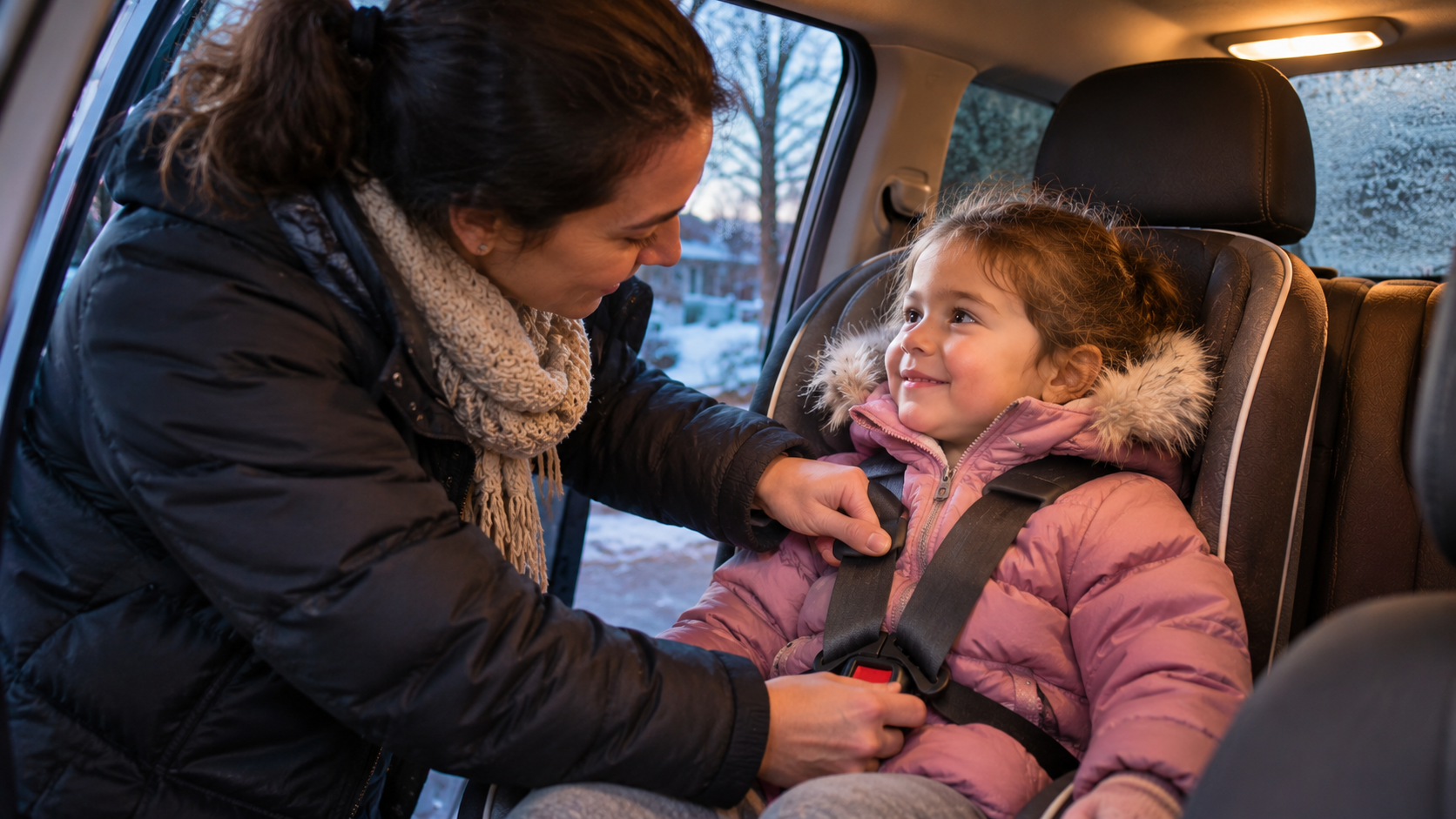
It’s 7:10 on a January morning, and the windshield is still white. Your three-year-old is already zipped into her puffy coat, so you lift her into the car seat, buckle the harness, and pull the strap until it feels snug.
Everything feels right. But the coat is doing something you can’t see.
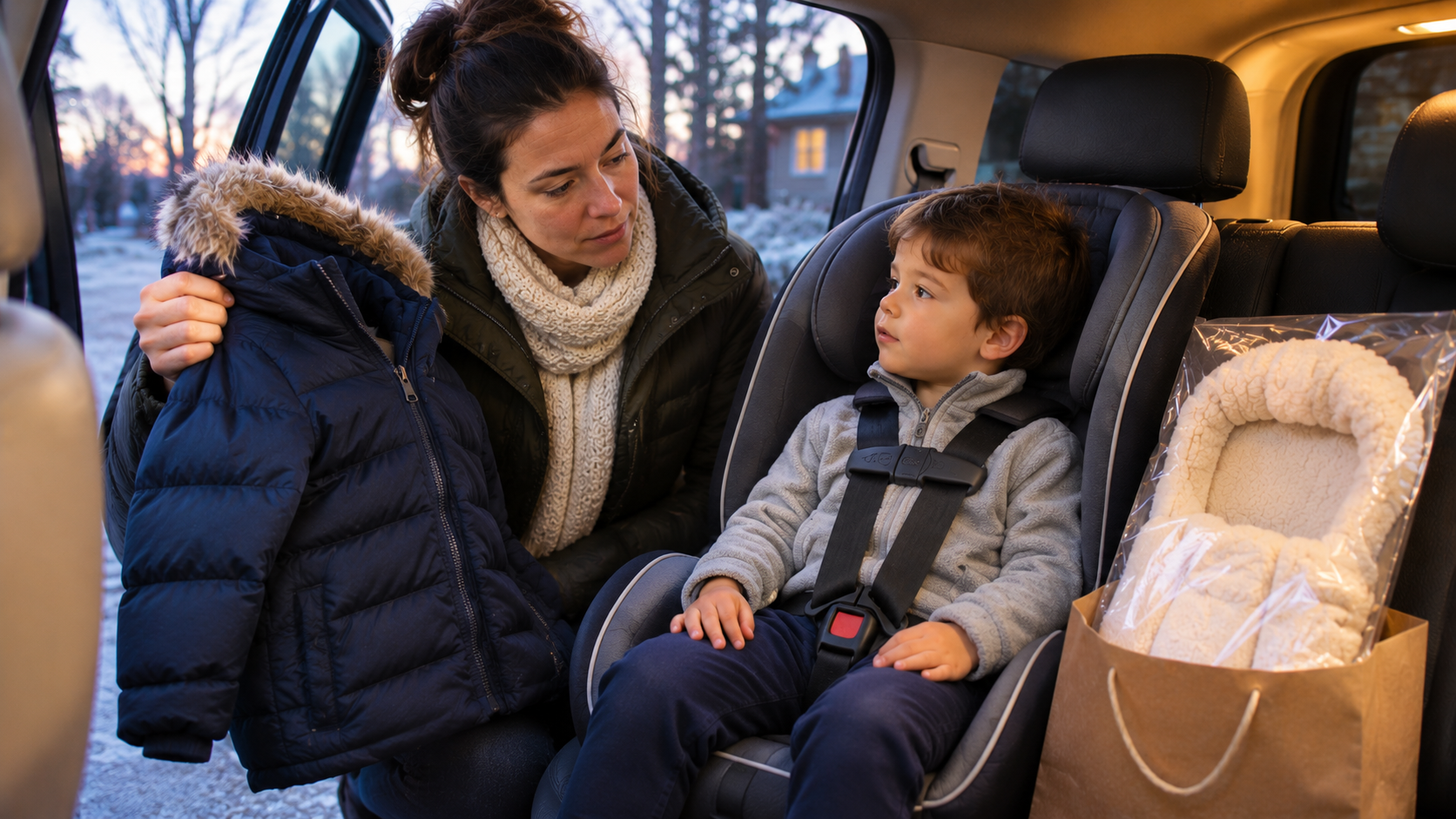
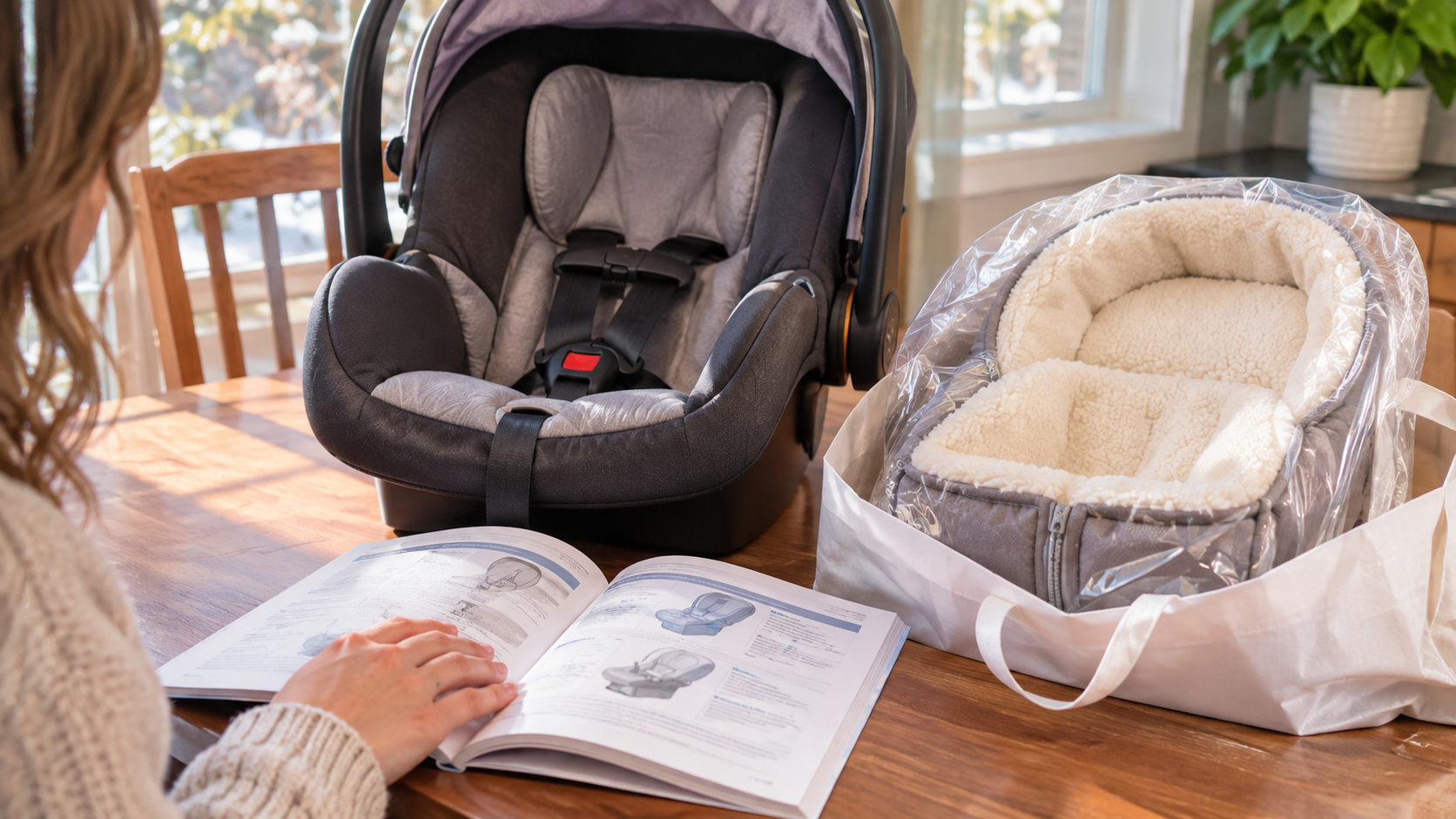
Meanwhile, in the back of the car, still in its shopping bag, sits the plush car seat insert you bought last week because the box promised warm and safe.
This guide is about both of those decisions: what your child wears under the harness, and what you add to the seat.
Why a Puffy Coat Fools the Harness
A harness keeps your child restrained in a crash and spreads the crash forces across the strongest parts of the body, the hips and chest. To do that job, it needs to fit snugly, with no bulky padding underneath.
That’s the trouble with puffy coats. According to the American Academy of Pediatrics, the fluffy padding in a coat flattens out immediately in a crash, leaving extra space under the harness. A child can then slip through the straps.
NHTSA describes the same problem: too much bulk creates extra room in the harness, a loose fit, and a risk of injury in a crash.
In other words, the strap felt tight because it was pressing on padding. Once that padding compresses, the slack appears at the worst possible moment.
For that reason, the AAP’s general rule is simple: bulky clothing, including winter coats and snowsuits, should not be worn under a car seat harness.
Your seat’s manual says something similar. Federal rules require car seat instructions to explain that a snug strap “should not allow any slack.”
Tighten First: The Pinch Test
Before you think about warmth, start with fit.
NHTSA’s check takes a few seconds. With your child buckled in, try to pinch the harness strap at the shoulder between your thumb and forefinger, gathering any extra material into a small up-and-down fold. If your fingers slide right off and you can’t pinch any webbing, the harness is tight enough.
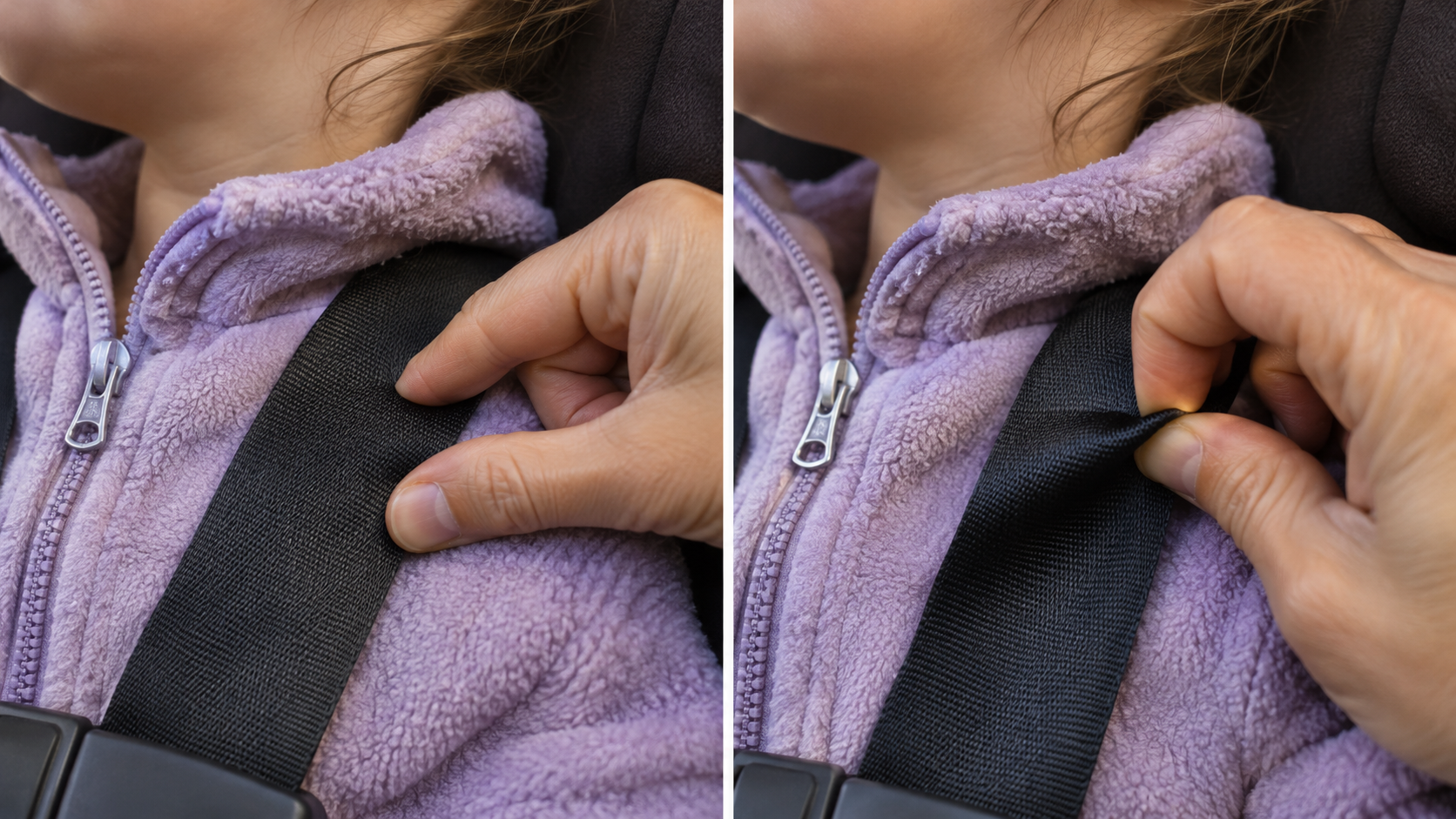
Can you pinch a fold? Then it’s too loose. Tighten it and check again.
While you’re there, look at the whole harness. It should lie flat and fit snugly at the shoulders and hips, with the chest clip at armpit level.
Does Your Child’s Coat Pass? The Coat Test
Not every jacket is a problem. A thin layer and a puffy coat behave very differently, and the coat test is a simple way to check whether a coat leaves extra room under the harness.
Children’s Wisconsin, a pediatric hospital system, describes a simple test. First, put the coat on your child, buckle them in, and tighten the harness. Next, without loosening the straps, unbuckle your child and take them out.
Then take the coat off and buckle your child back in, again without adjusting the straps. If the harness is now loose, the coat is too thick to wear under it.
Still, keep in mind what this test can and can’t tell you. It checks for hidden slack; it doesn’t measure crash performance. A coat that passes isn’t “crash tested” or certified. It simply didn’t show hidden slack in that check, for your child, in your seat.
The same goes for coats sold as “car seat safe.” A label like that doesn’t replace the test.
At a Glance: Two Checks, Two Different Jobs
| Check | What it tells you | What it doesn’t tell you |
|---|---|---|
| Pinch test | Whether the harness is tight enough right now: no webbing to pinch at the shoulder | Whether a bulky layer underneath is hiding slack; that’s what the coat test is for |
| Coat test | Whether hidden slack showed up in that check, for your child, in your seat | Crash performance; a coat that passes isn’t “crash tested” or certified |
Then Warm: What Goes Over the Harness
Once the harness passes the pinch test, warmth goes on top.
The AAP and NHTSA suggest the same basic moves. Dress your child in thin layers; NHTSA specifically mentions lightweight fleece instead of puffy materials. After buckling, add a blanket over the harness, or put your child’s coat on backwards, over the buckled straps.
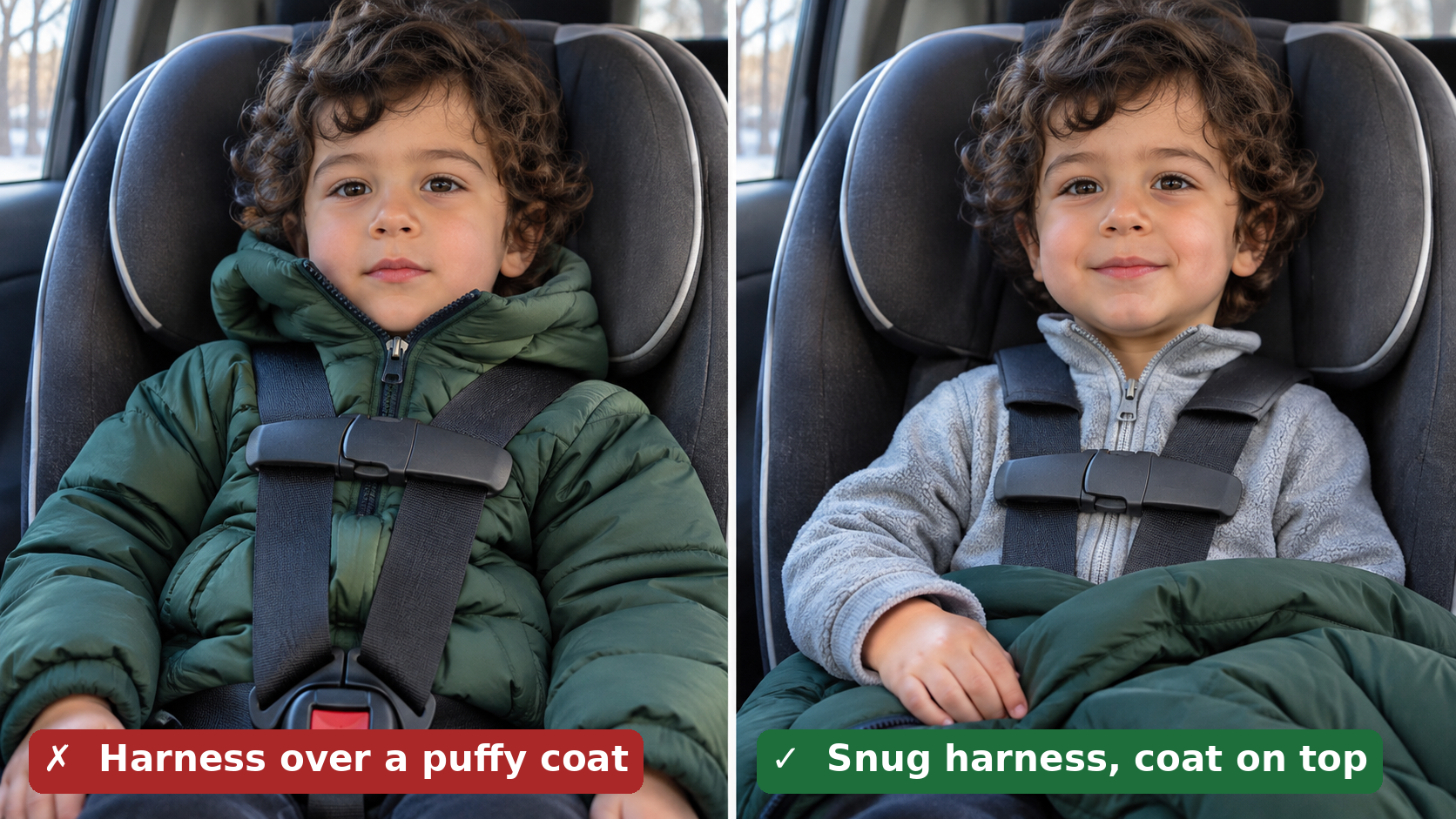
Some parents prefer poncho-style coats, or jackets that zip down the sides so the back can flip forward over the harness, the AAP notes.
Even so, “over the harness” isn’t a free pass. The AAP adds conditions. A car seat cover is only an option if it has no layer under the baby. Your baby’s face should stay uncovered. And the top layer should be removable, so your child doesn’t get too hot once the car warms up.
For infants, the AAP has one more practical tip: keep the carrier part of the seat inside the house when you’re not using it. A room-temperature seat pulls less heat from your baby.
Over, Not Under: The Products Sold as the Fix
This is where winter shopping gets tricky.
Store shelves and online listings are full of car seat buntings, sleeping-bag inserts, and padded strap covers. Some are sold as a way to keep kids warm in the car seat.
Here’s the line the AAP draws: if an item did not come with the car seat, it has not been crash tested with it and may interfere with the protection the seat provides. The AAP also says never to use sleeping bag inserts or other stroller accessories in a car seat.
So the useful question isn’t “does this look cozy?” It’s where the product sits.
| Where it sits | Examples | What to know |
|---|---|---|
| Over the buckled harness | Blanket, coat on backwards, poncho, cover that stretches over the top of an infant seat | AAP and NHTSA suggest a blanket or a backwards coat once the harness is snug; the AAP allows a cover only if nothing goes under the baby and the face stays uncovered |
| Under or behind your child, or on the straps | Bunting with slots for the harness, plush inserts, padded strap covers from another brand | Didn’t come with your seat and may interfere with its protection; check your seat’s manual and its maker’s approval for that model first |
| On your child | Puffy coats, thin jackets, coats sold as “car seat safe” | Run the coat test, whatever the label says |
What “Crash Tested” on the Box Can and Can’t Tell You
Car seats themselves must meet a federal safety standard. However, NHTSA has explained that this standard doesn’t directly apply to accessories sold separately.
In a 1995 letter to a company planning a bunting with slots for the harness, the agency named examples of those accessories: pillows, pads, and buntings. The same letter described the risk: if a liner compresses, or the straps bind up on it, the shoulder straps can move off a baby’s shoulders, and the baby can be ejected from the seat.
That doesn’t mean accessory makers face no rules at all. In a 2006 letter about a seat cover, NHTSA noted that the maker is still responsible for safety defects and recalls, and recommended that a cover not interfere with the belts that restrain the child.
Nor does it mean anyone in government checked the product. NHTSA has explained in several interpretation letters that it does not approve or certify vehicles or equipment; for products a federal standard covers, manufacturers certify compliance themselves. In a 1993 letter, the agency went further. It told the maker of an aftermarket seat cover not to claim on the packaging that the product complied with federal standards, because none applied to it and the claim could mislead consumers.
Keep the limits of that letter in mind, though. A claim of federal compliance and a claim of crash testing are different things. Of course, a company may well have run tests of its own. What you can’t assume is that those tests prove the product works with your seat.
That’s why the decision comes back to the seat. Before you add any accessory, check your car seat’s instructions, and look for specific approval from your seat’s manufacturer for that model.
Booster Riders: It’s the Belt, Not the Harness
Older kids in a booster seat don’t use a harness. Instead, they use the vehicle’s seat belt, so the pinch test isn’t the right check.
What matters, according to NHTSA, is belt fit. The lap belt should sit low across the upper thighs and hips, not the stomach, and the shoulder belt should lie snugly across the shoulder and chest, not on the neck or face.
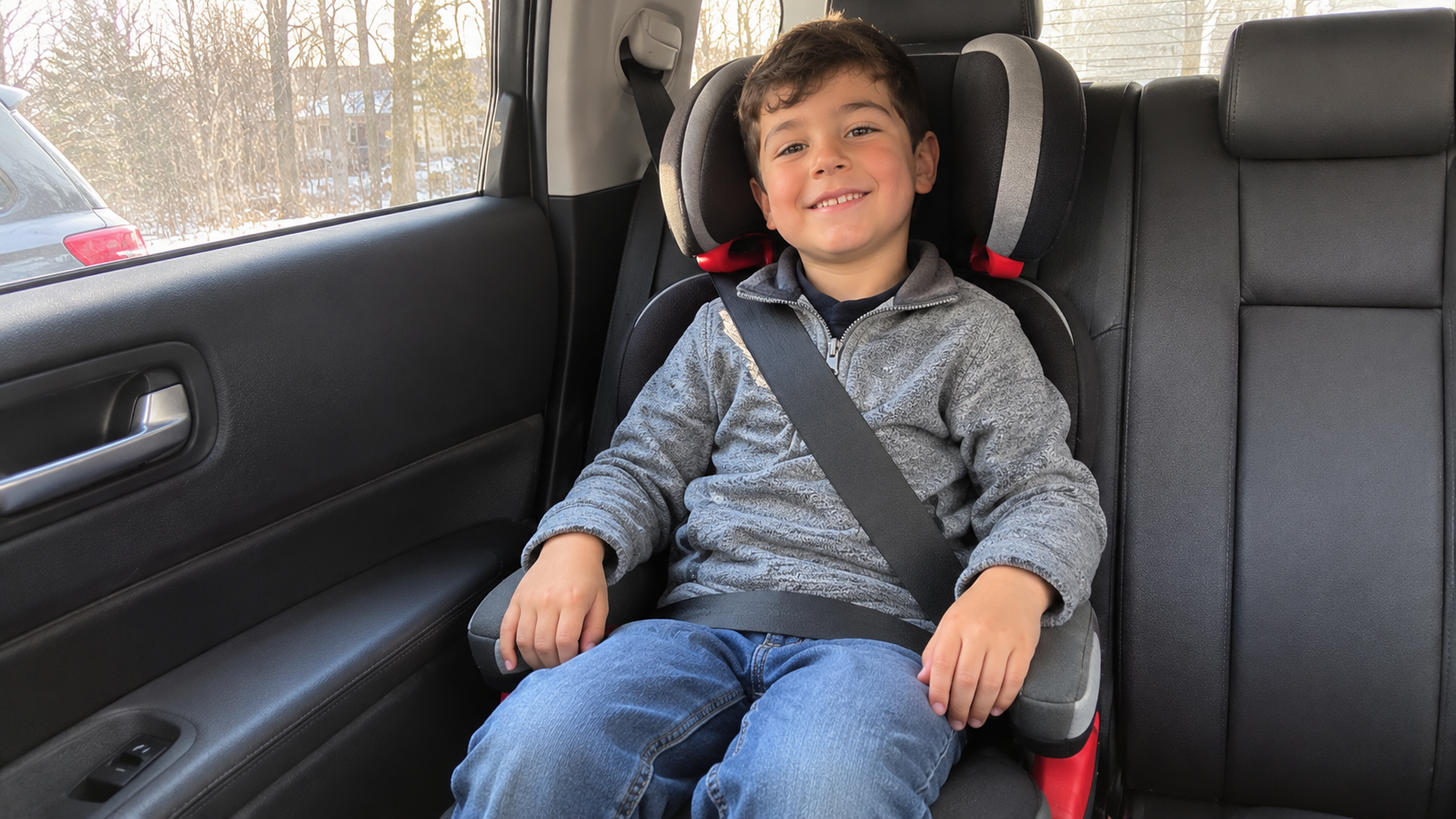
Even so, the coat principle still holds. The AAP says its winter tips apply to all ages, and notes that even for adults, a puffy coat under a seat belt isn’t a best practice, because it adds space between the body and the belt.
For booster riders, Children’s Wisconsin suggests buckling the seat belt first, then putting the coat on backwards over the arms and shoulders.
Before You Pull Out of the Driveway
- Did the harness pass the pinch test, with nothing bulky underneath?
- If my child is wearing a jacket, has it passed the coat test in this seat?
- Is anything under or behind my child that didn’t come with the seat, and has my seat’s manufacturer approved it for this model?
- Is the warm layer on top, removable, and clear of my baby’s face?
- For my booster rider: is the belt low on the hips and across the shoulder?
Back to That Cold Morning
The coat comes off, or stays on only if it passed the coat test. Either way, the harness still has to pass the pinch test. Then the blanket or the backwards coat goes on top.
And the plush insert? It stays in the bag unless your car seat’s manufacturer specifically approves it for that model.
Tighten first. Then warm. Over, not under.
It isn’t a guarantee for every product on the shelf. Instead, it’s the order that lets the harness do its job.
Sources
- American Academy of Pediatrics (last updated 2025). Winter Car Seat Safety Tips: Keeping Kids Safe & Warm. HealthyChildren.org. Link.
- National Highway Traffic Safety Administration. Keep Your Little Ones Warm and Safe in Their Car Seats. NHTSA.gov. Link.
- National Highway Traffic Safety Administration (2025). How To Use a Car Seat Harness (handout). TrafficSafetyMarketing.gov. Link.
- National Highway Traffic Safety Administration (2024). Booster Seats: Keeping Your Big Kids Safe (handout). TrafficSafetyMarketing.gov. Link.
- Children’s Wisconsin. Puffy Coats and Car Seats (teaching sheet #1417). Wisconsin Child Passenger Safety. Link.
- 49 CFR § 571.213, Standard No. 213, Child restraint systems, S5.6.3 (car seats made before December 5, 2026). Electronic Code of Federal Regulations, via Cornell LII. Link.
- 49 CFR § 571.213b, Standard No. 213b, Child restraint systems, S5.6.3 (car seats made on or after December 5, 2026). Electronic Code of Federal Regulations, via Cornell LII. Link.
- NHTSA Office of Chief Counsel (1993). Interpretation 8408: aftermarket child seat cover. NHTSA.gov. Link.
- NHTSA Office of Chief Counsel (1995). Interpretation 10536bun: bunting for an infant seat with harness slots. NHTSA.gov. Link.
- NHTSA Office of Chief Counsel (2006). Interpretation 06-001831: child seat cover. NHTSA.gov. Link.
- NHTSA Office of Chief Counsel (2008). Interpretation 08-001245: aftermarket harness buckle pad. NHTSA.gov. Link.