
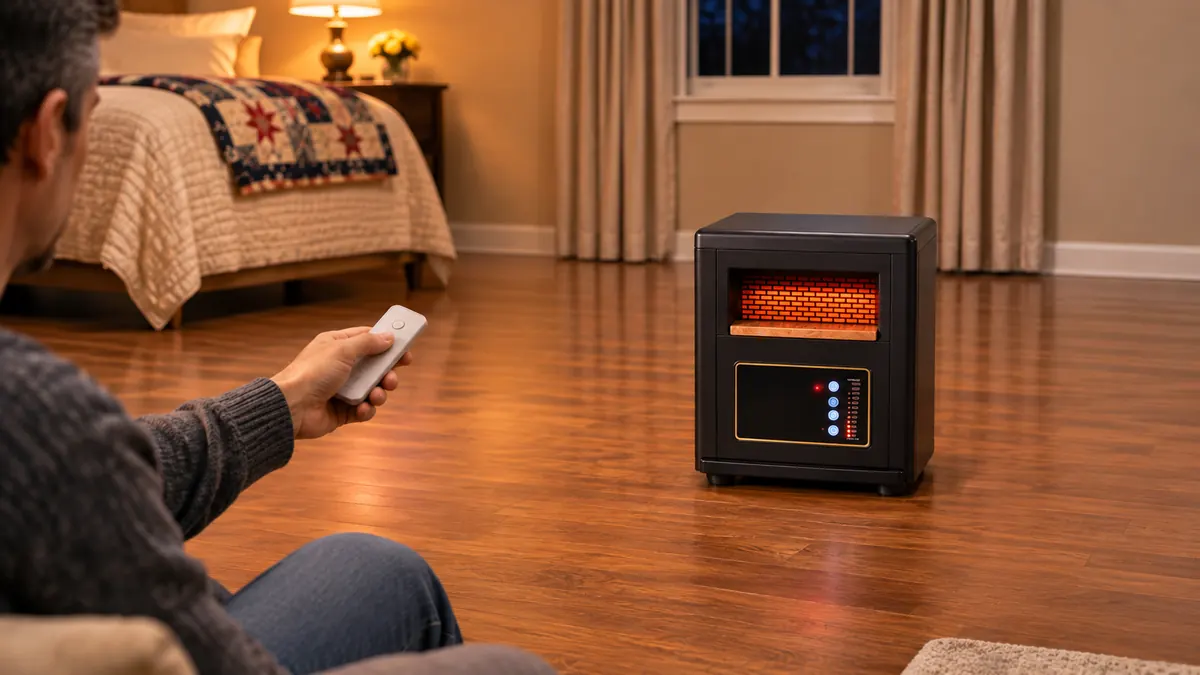
It’s the first cold night of the season. The baby’s room is the chilliest in the house, so the heater comes out of the closet, gets set down a careful distance from the crib, and clicks on.
Most parents know the rule that comes next: keep it three feet from anything that can burn. That rule is real, and it targets the factor fire departments report most often. But it covers only one of the ways a space heater starts a fire.
A safe space heater setup isn’t only about three feet of clearance. It’s about anticipating how this heater, in this room, with these people, could start a fire — and what would happen if it did.
The three-foot rule is real. It just isn’t the whole picture.
Start with what fire departments actually record. In U.S. Fire Administration data on portable heater fires in homes from 2017 to 2019, the most common contributing factor was a heat source too close to something that could burn: 47.9% of the fires where a factor was identified. USFA’s portable-heater category includes catalytic, oil-filled and electric heaters designed to be moved between locations. These figures are not limited to portable electric heaters.
That’s exactly the problem the three-foot rule exists to prevent, which is why it comes first.
Still, the same data lists other factors: an electrical failure or malfunction (12.1%), equipment left unattended (10.0%), a short-circuit arc (5.3%) and a mechanical failure (4.9%). Because one fire can involve more than one factor, these numbers don’t add up to a neat total. What they do show is that proximity was the most frequently identified factor in this data, but not the only one.
At a Glance: Contributing Factors → Portable Heater Fires
| Contributing factor (USFA, 2017–2019) | Share of fires where a factor was identified |
|---|---|
| Heat source too close to something that could burn | 47.9% |
| Electrical failure or malfunction | 12.1% |
| Equipment left unattended | 10.0% |
| Short-circuit arc | 5.3% |
| Mechanical failure | 4.9% |
These fires are also unusually deadly. Portable heaters were involved in just 3% of residential heating fires in that period, yet in 41% of the heating fires that killed someone. The National Fire Protection Association sees a similar pattern in a broader category, space heaters and heating stoves: 30% of home heating equipment fires from 2020 to 2024, but 73% of the deaths and 70% of the injuries.
So this guide follows the order a fire would: the space around the heater, the electricity feeding it, the people watching it — and what happens if all of that fails.
Along the way, it borrows from safety agencies abroad. Japan’s product-safety agency and the U.K.’s medicines regulator describe a few of these risks in more specific detail than the usual American checklists. Those details are worth bringing home.
1. Clear the space — and count the people in it
The rule is three feet from anything that can burn: beds, clothes, curtains, papers, sofas. NFPA adds two details that are easy to skip. The three feet apply to people too, and children get a three-foot “kid-free zone” around the heater.
Where the heater sits matters as much as how far. In USFA’s data, a third of portable heater fires (33.6%) started in bedrooms, and in those fires bedding was the leading item first ignited.
In other words, the cold-bedroom scene is the one to get right.
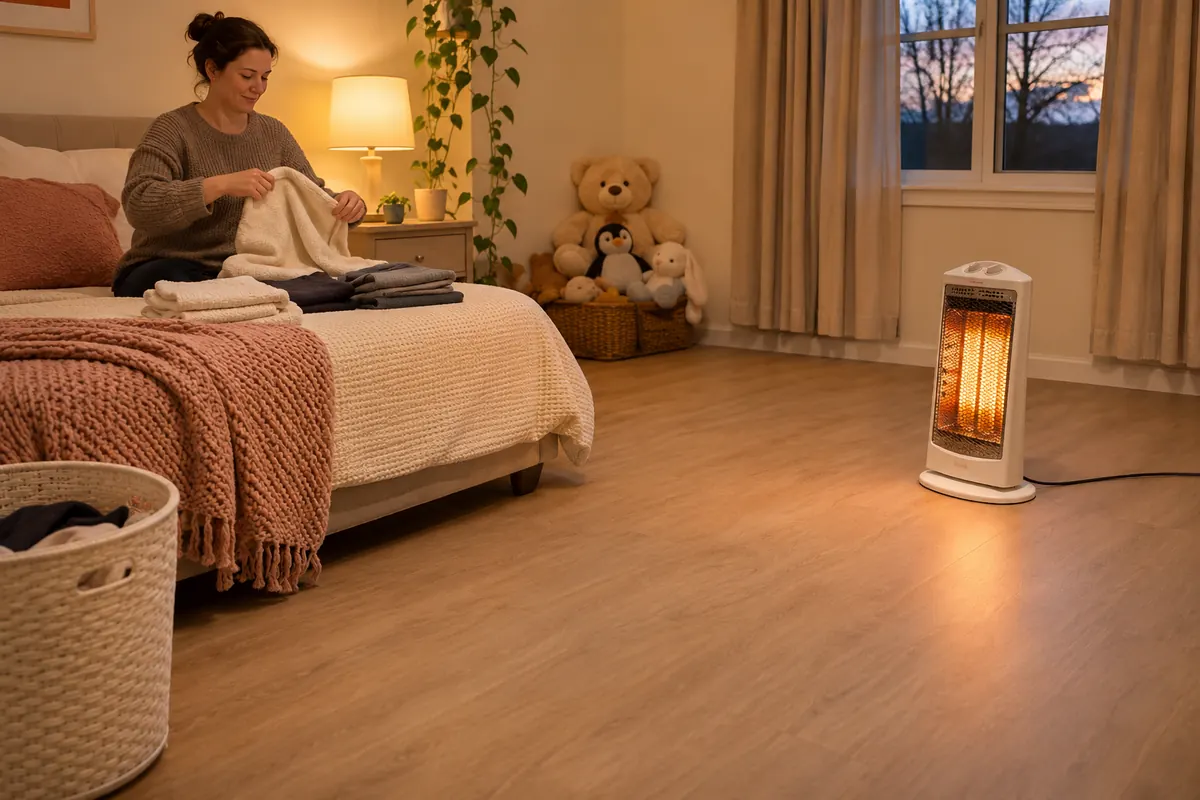
Mind the distance between the heater and you
London Fire Brigade aims part of its advice at the person, not just the furniture: sit at least one meter (a little over three feet) from a heater, especially if you might fall asleep, because your clothes or your chair can catch fire.
Japan’s product-safety agency, NITE, adds a winter detail that’s easy to miss. Thick, layered clothing makes it harder to notice that fabric is getting dangerously hot. Put differently, thick layers can delay the moment you realize your clothes are getting too hot.
And never use a heater to dry clothes. London Fire Brigade lists drying clothing on heaters among the common causes of heater fires. Japan’s NITE and New Zealand’s fire service give the same warning.
Think about who could knock it over — or cover it
Keep the heater out of walkways, and never let it block an exit. London’s firefighters also warn that people with limited mobility are more likely to be fatally hurt in heater fires, and that children and pets can knock a heater over or cover it up, which can make it overheat.
For a home with grandparents, toddlers or a dog, that means choosing the heater’s spot by asking who walks past it, not only what sits near it.
A risk most checklists miss: skin cream on fabric
If someone in your home uses emollient creams — common for eczema and very dry skin — there’s one more thing to know. Britain’s medicines regulator, the MHRA, warns that cream can transfer onto clothing, bedding and dressings, dry there and build up over time. Once it does, it acts as an accelerant: the fabric ignites more easily and burns more intensely.
The MHRA is clear that the creams aren’t flammable in themselves or on the skin; the hazard is the residue on fabric. The warning covers all emollients, including paraffin-free ones. Even so, the MHRA stresses that the risk is very small and that people should keep using their creams as directed.
The practical step is simple. Keep clothing and bedding that may carry cream residue away from the heater, and don’t sit close to a heater while wearing it. Washing at high temperature reduces the buildup, but the MHRA notes it doesn’t remove it completely.
2. The plug, the cord and the heater itself
Plug the heater directly into a wall outlet — never into an extension cord or a power strip. Fire departments also repeat NFPA’s advice to plug in only one heat-producing appliance per outlet at a time. And never run the cord under a rug.
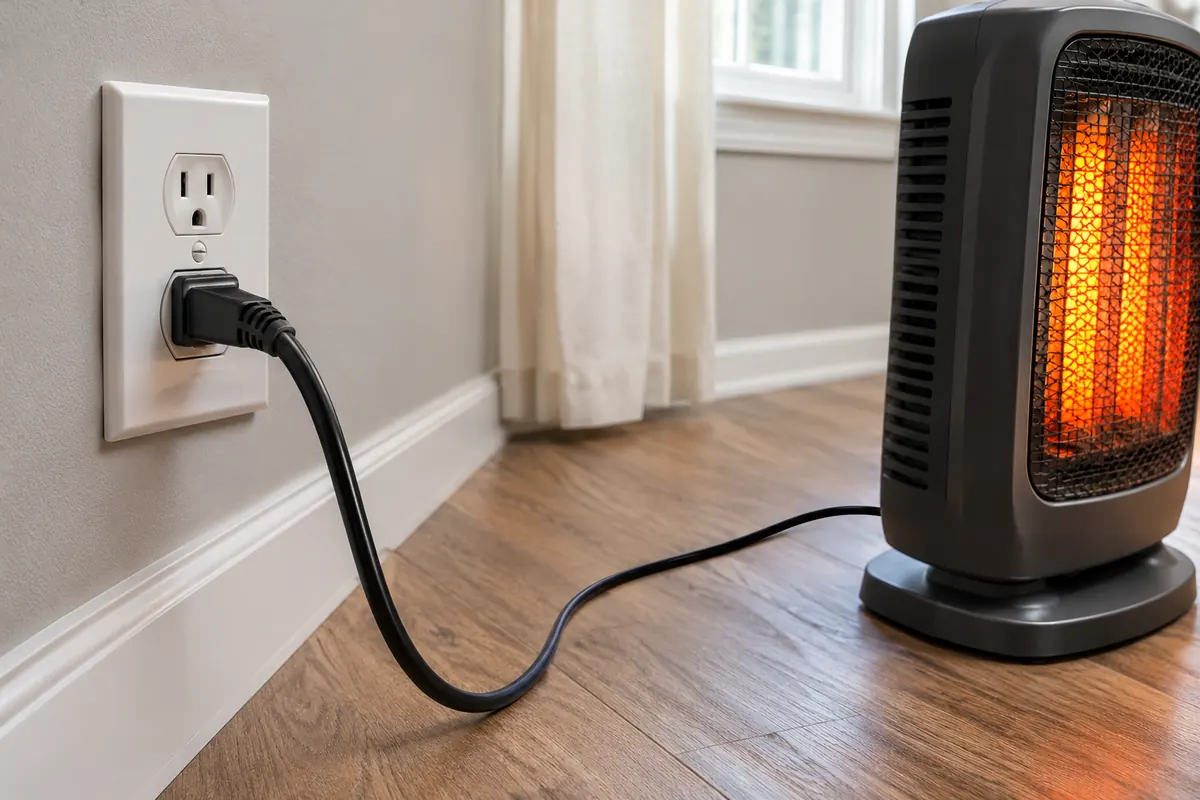
Pay attention to heat where it shouldn’t be. If you notice the heater’s cord or plug is hot, CPSC says to disconnect the heater and contact an authorized repair person; if any part of the outlet is hot, call a certified electrician.
Why a cool plug isn’t proof
Here’s the catch: some problems don’t announce themselves with heat. Investigating heaters with heat-damaged plugs, CPSC engineers found inconsistent crimping, welding and soldering inside the plugs, where the blades connect to the cord. They needed X-rays and CT scans to see it. A plug that feels fine can still hide a defect.
That’s why two habits spelled out in more detail by Japan’s NITE — checking the cord and learning the warning signs — are worth adopting.
Before the season: check the cord with the heater unplugged
With the heater off, unplugged and cool, look over the cord and plug. NITE singles out the two spots where cords tend to fail — near the plug and where the cord enters the heater — and suggests checking them for cracks, stiffness or other damage. A plug that looks deformed, discolored or melted is a reason to stop using the heater and contact the manufacturer. And once you plug it back in, it shouldn’t sit loose in the outlet.
Check the recall list — by model and date
Recalls aren’t old news. On October 29, 2026, CPSC announced the recall of about 338,800 DREO ceramic space heaters, model DR-HSH015, made from April 2025 through January 2026, after 17 reports of the heaters igniting. They were sold through October 2026, which makes the recall especially relevant as this heating season begins.
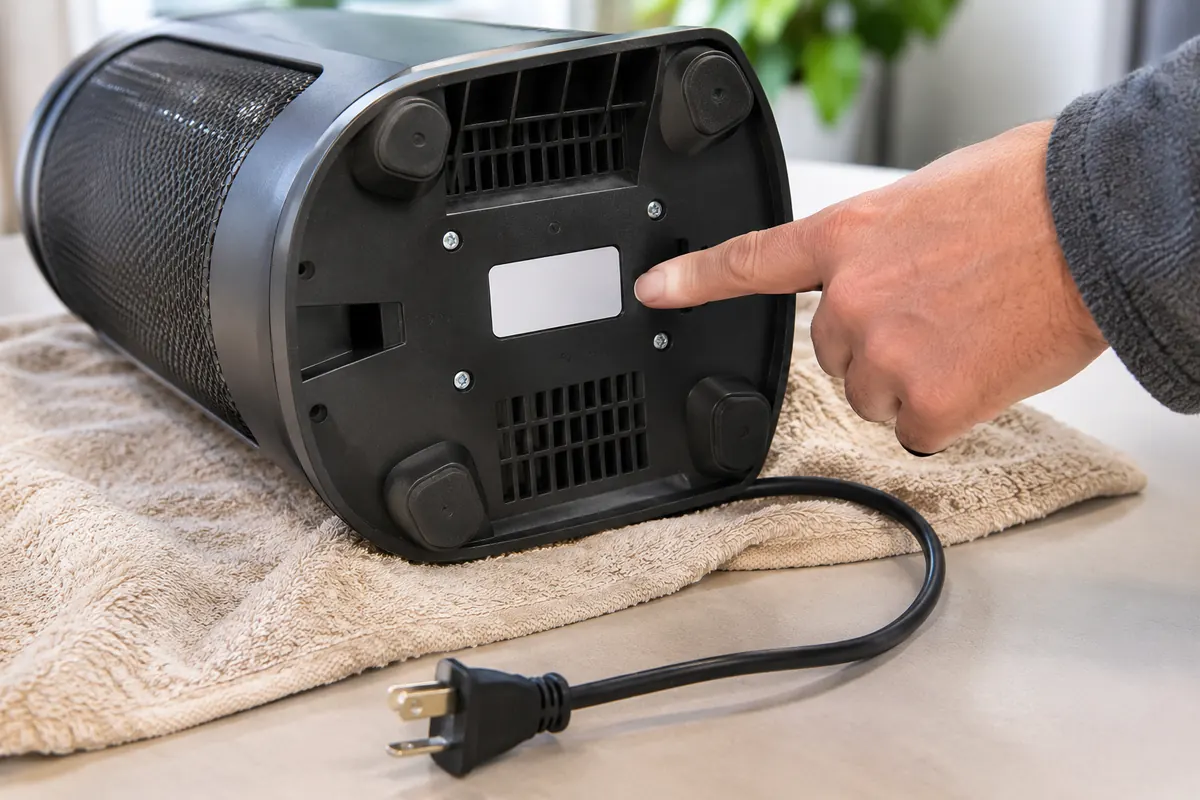
The model number and manufacture date are printed on a label under the heater. Turn it off, unplug it and let it cool before you tip it to look. If yours is included, stop using it and contact DREO for a free replacement; the recall notice explains the steps. For any heater, search the exact model at cpsc.gov/recalls.
While it runs: learn the warning signs
NITE lists signs that can appear before a heater catches fire:
- part of the heater’s body looks discolored or deformed
- crackling or popping sounds while it runs
- the heat or fan cuts out now and then, especially when the cord moves
- a burning smell, or a spot that gets unusually hot
If you notice any of these, turn the heater off, unplug it and contact the manufacturer.
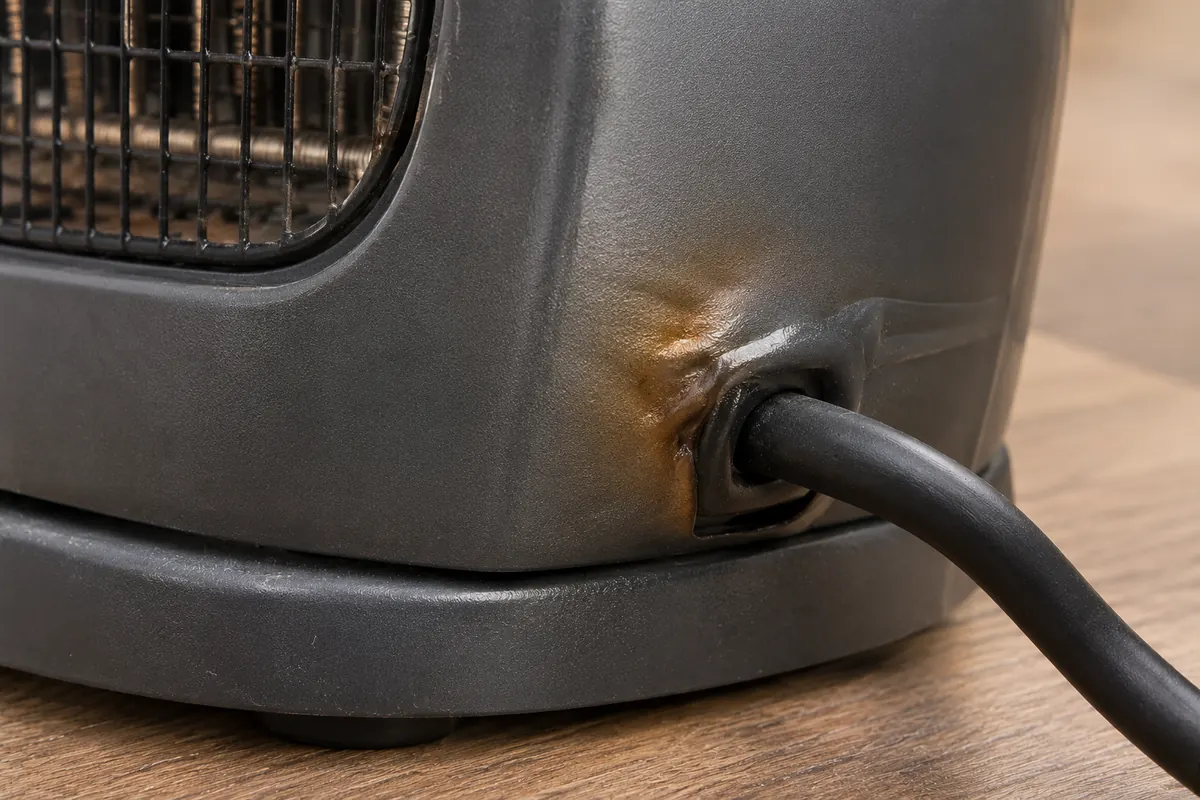
These signs aren’t hypothetical. In NITE’s records of electric-heater incidents in Japan from 2020 to 2024, the most frequent identified causes were faults in internal wiring, recalled products that were never fixed, and power cords broken by repeated bending. Because that’s a product-incident database rather than fire-department data, its numbers can’t be compared with U.S. statistics. Even so, the pattern points straight at the cord and the recall list.
What the safety features do — and don’t
Buy a heater with the mark of a recognized testing laboratory, and look for a thermostat, overheat protection and an automatic shutoff if it tips over.
But know what that tip-over promise means today. A heater listed to UL’s standard must pass a tip-over test, yet it can do so with temperature controls instead of a dedicated switch. Under the May 2025 revision of the standard, movable heaters rated below 208 volts will need a tip-over switch to be certified. Intertek, one of the labs that certifies heaters to this standard, lists December 12, 2028, as the effective date for the new requirements. That’s a change to a voluntary certification standard, not a federal law. Japan, by comparison, has required heaters made since 2017 to stop heating when they’re tipped over.
NITE recommends checking at the start of each season that the tip-over shutoff still works. Since models differ, check your manual for whether yours has one and how to test it safely. Don’t improvise with a hot heater.
3. Who’s watching — and when it goes off
The simplest rule is also easy to skip: turn the heater off when you leave the room or go to bed.
An automatic shutoff doesn’t replace that habit. It’s a backup for an accident, not permission to sleep with the heater running.
Nighttime deserves special care. In NFPA’s analysis of home heating fires from 2016 to 2020, the hours between midnight and 6 a.m. accounted for 13% of the fires but a disproportionate share of the deaths. As NFPA notes, people are likely to be asleep at that hour and farther from a way out, so they have less time to respond.
A note for the nursery
CPSC flags a second danger besides fire: overheating. Portable heaters can create a hyperthermia hazard, particularly for children, older adults and people with disabilities, who may not be able to react to a room that’s getting too hot. CPSC’s advice is not to leave a heater running unattended in a confined space around infants or anyone with reduced physical, sensory or mental abilities.
4. If a fire starts anyway
Prevention can fail, and heater fires tend to spread. In USFA’s data, half of portable heater fires spread beyond the room where they started, compared with about a third of other nonconfined residential heating fires.
That’s the second half of the thesis: what happens next depends on things far from the heater.
The January 2022 Twin Parks fire in the Bronx shows how. A malfunctioning electric space heater started it. According to the Bronx borough president’s testimony to Congress, the fire itself was contained to the apartment and the adjacent hallway. However, the apartment door didn’t close behind the family as they escaped, and smoke spread through the building. All 17 people who died were killed by smoke inhalation.
Close the door — before bed and on the way out
Doors buy time. In a full-scale experiment by UL’s Fire Safety Research Institute, with a fire set in a living room, a closed bedroom stayed around 100°F with about 600 ppm of carbon monoxide. Meanwhile, an open bedroom reached about 500°F and 6,000 ppm.
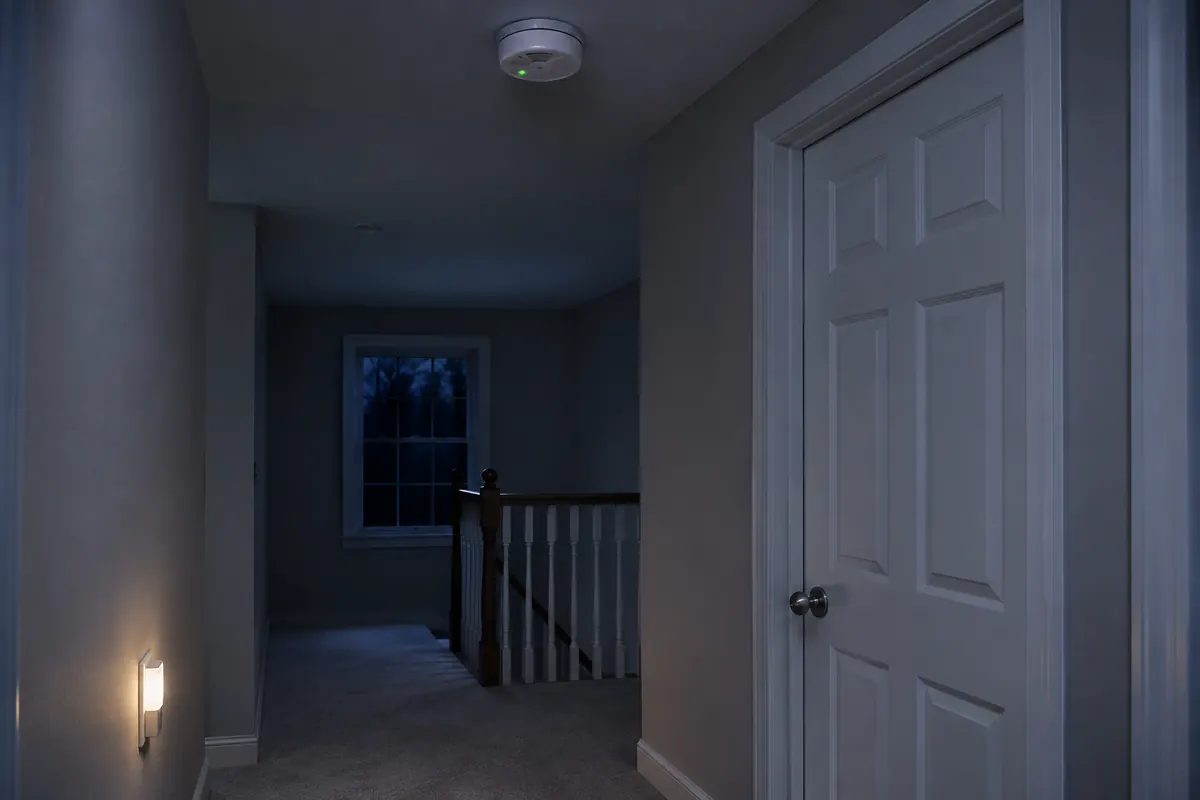
One limit matters here. A closed door can slow smoke and heat from a fire that starts outside the room. It won’t stop a heater inside that same room from starting one, and it doesn’t make that setup safe. That’s why the heater rules come first.
Make sure an alarm will wake you
In USFA’s data on occupied homes, smoke alarms were reported present in 41% of portable heater fires and absent in 33%; in the remaining 26%, firefighters couldn’t determine whether one was there. CPSC recommends smoke alarms on every level and inside every bedroom, tested monthly, and interconnected so that when one sounds, they all sound.
When the power goes out
A portable power station can run an electric heater only if its continuous AC output is at least the heater’s wattage, and even then, not for long. Take a heater drawing 1,500 watts on a 1,000 Wh station: the ideal math (1,000 ÷ 1,500) gives about 40 minutes, and real runtime is shorter once usable capacity and conversion losses are counted. We explain why that label number overstates real runtime in our guide to portable power station capacity.
A battery doesn’t change the rules, either: the heater still needs someone awake and nearby. As for generators, CPSC says to run them outdoors only, at least 20 feet from the home, and never in a house, basement or garage.
Fuel-burning heaters, such as kerosene and propane models, bring a different danger, carbon monoxide, and deserve their own guide. If you use one, follow the manufacturer’s fuel instructions and have CO alarms on every level and outside sleeping areas.
The short version
Clear the space. Plug it into the wall. Turn it off when you walk away. Sleep with the bedroom door closed — and know your way out.
The three-foot rule is where heater safety starts. It isn’t where it ends: the cord, the label underneath, the person dozing nearby and the door down the hall all help decide how a cold night turns out.
Sources
- U.S. Fire Administration (2021). Portable Heater Fires in Residential Buildings (2017-2019). Topical Fire Report Series, Vol. 21, Issue 11. Link.
- National Fire Protection Association (2026). Safety with heating equipment — heating fire statistics, 2020–2024 annual averages. NFPA. Link.
- Campbell, R. (2022). Home Heating Fires (2016–2020 data), including fires by time of day and NFPA’s heating safety practices. NFPA Research. Link.
- National Fire Protection Association (2018). Electric Portable Space Heater Safety (tip sheet). NFPA Public Education. Link.
- City of Billings, Montana. Heating Safety (NFPA advice on one heat-producing appliance per outlet). Link.
- U.S. Consumer Product Safety Commission (2026). Keep Warm and Safe This Winter: Tips for Using Generators, Furnaces and Space Heaters. CPSC.gov. Link.
- U.S. Consumer Product Safety Commission. 7 Highly Effective Portable Heater Safety Habits. Neighborhood Safety Network. Link.
- U.S. Consumer Product Safety Commission (2023). CPSC Warns Consumers to be Cautious When Using Space Heaters, Furnaces and Fireplaces This Winter (hyperthermia hazard). CPSC.gov. Link.
- U.S. Consumer Product Safety Commission. Voluntary Standards: Electric Heaters (staff findings on heater power-cord plugs). CPSC.gov. Link.
- U.S. Consumer Product Safety Commission (2026). DREO Recalls DR-HSH015 Space Heaters Due to Fire and Burn Hazards (Recall 27-054). CPSC.gov. Link.
- UL (2009). Electric Heaters: Tip-over Protection. The Code Authority. Link.
- Intertek (2025). Standards Update Notice: UL 1278, Movable and Wall- or Ceiling-Hung Electric Room Heaters (effective December 12, 2028). Link.
- National Institute of Technology and Evaluation, NITE (2025). Heater accident prevention: four inspection points plus one caution during use (in Japanese). NITE, Japan. Link.
- London Fire Brigade (2021). Brigade issues heating warning as temperatures drop and people still work from home. London-fire.gov.uk. Link.
- Medicines and Healthcare products Regulatory Agency and National Fire Chiefs Council. Risk of severe and fatal burns with emollients: information for healthcare professionals. GOV.UK. Link.
- Fire and Emergency New Zealand. Winter fire safety (electric heaters). Link.
- Gibson, V. L. (2022). Testimony before the U.S. House Subcommittee on Housing, Community Development, and Insurance on the Twin Parks North West fire. Link.
- UL Fire Safety Research Institute (2017). The Close Before You Doze Series: Before & After. FSRI. Link.



Comments
2 responses to “Three Feet Isn’t the Whole Rule: How Space Heaters Actually Start Fires”
[…] above) or “up to 30 watts” (as ADAC measured), that overhead barely registers against a 380W space heater — a rounding error of a few percent. Against a 34W CPAP machine or a phone charger, that same […]
[…] above) or “up to 30 watts” (as ADAC measured), that overhead barely registers against a 380W space heater — a rounding error of a few percent. Against a 34W CPAP machine or a phone charger, that same […]